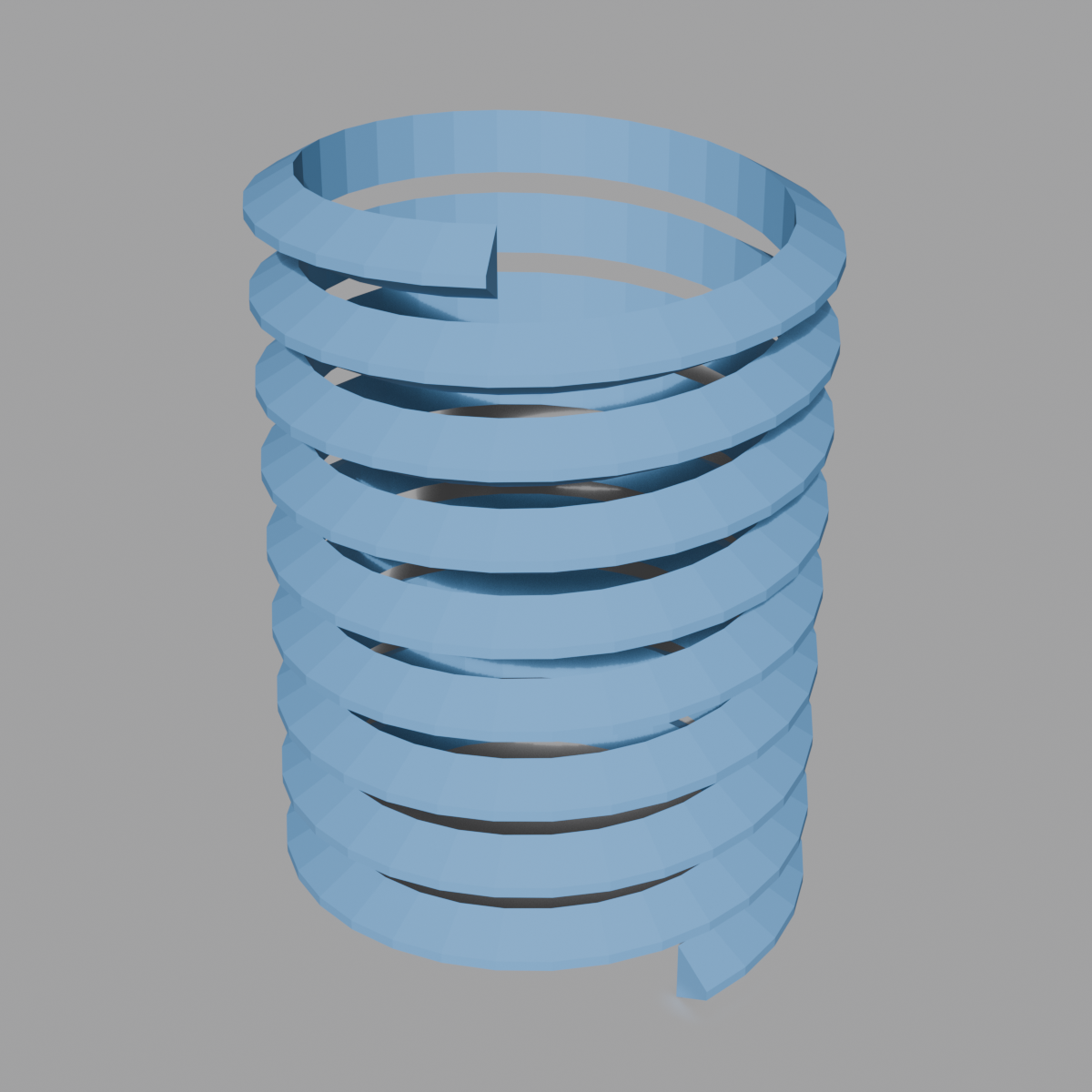
fasteners/threaded_fastener.py → OBJECT_OT_add_threaded_fastener (object.add_threaded_fastener, "Add Threaded Fastener")
Generates a single thread-helix solid, meant to be combined with other geometry via a manual boolean in the same session — this operator never does the union/difference itself. It's the primitive both hex_bolt.md and hex_nut.md build on (by duplicating its math, not importing it — see README.md).
The four mode combinations
thread_type |
operation |
Meaning | Output name |
|---|---|---|---|
| EXTERNAL | ADDITIVE | Bolt-type ridge, union onto a shaft | ExternalThread |
| EXTERNAL | SUBTRACTIVE | Cut external threads into a cylinder | ExternalThreadCutter |
| INTERNAL | ADDITIVE | Nut-type ridge, union into a tube bore | InternalThread |
| INTERNAL | SUBTRACTIVE | Tap a hole (difference from a block) | TapCutter |
All four share identical helix-sweep math — only which compensation field applies and the output name differ. The profile shape is picked by a compact XNOR: if (thread_type == 'EXTERNAL') == (operation == 'ADDITIVE') use the external (ridge-out) profile, else the internal (ridge-in) profile — i.e. External+Additive and Internal+Subtractive share a profile, and External+Subtractive and Internal+Additive share the other. That's because a cutter is always the opposite profile of its same-named additive counterpart.
Properties
| Property | Type | Default | Range | Notes |
|---|---|---|---|---|
target | Object pointer | — | fastener objects with the OPPOSITE orientation — see Match Target below | Match Target; runs fastener_matching.sync_raw_thread |
thread_type | Enum | EXTERNAL | EXTERNAL/INTERNAL | Forced to the opposite of the target's orientation whenever a target is set — see below |
operation | Enum | ADDITIVE | ADDITIVE/SUBTRACTIVE | |
diameter_mm | Float (mm) | 8.0 | 0.5–100 (soft) | Nominal major diameter, crest-to-crest |
pitch_mm | Float (mm) | 1.25 | 0.1–10 (soft) | Distance between thread crests |
flank_angle_deg | Float (°) | 60.0 | 1–179 | 60° = metric/UNC, 55° = BSP, 29° = ACME |
truncation | Float | 0.125 | 0.0–0.3 | Crest flat as a fraction of pitch (ISO metric = 1/8). Root flat is always 2× this. |
height_mm | Float (mm) | 12.0 | 0.5–200 (soft) | Total thread length |
resolution | Int | 32 | 8–128 (soft) | Steps per revolution |
outer_compensation_mm | Float (mm) | 0.0 | 0.0–0.5 (soft) | Added to major diameter. Use for External+Additive (bolt) — printed external features shrink. |
inner_compensation_mm | Float (mm) | 0.0 | 0.0–0.5 (soft) | Added to major diameter. Use for Subtractive or Internal+Additive — printed holes come out tighter than designed. |
fit_offset_mm | Float (mm) | 0.0 | 0.0–0.5 (soft) | Fit adjustment for a mating External/Internal pair — subtracted from diameter when thread_type='EXTERNAL', added when 'INTERNAL', independent of operation. Never synced by Match Target |
_derive() applies whichever compensation field matches the active mode — outer_compensation_mm only for External+Additive, else inner_compensation_mm — and always adds it to major_r before re-deriving minor_r from the (now-larger) major radius. See README.md. fit_offset_mm is applied separately and first, keyed only on thread_type (not operation, which controls how the thread gets built, not which side of a mating pair it represents) — see threaded_container.md/threaded_lid.md for the same offset applied to a fixed-orientation pair.
Match Target
Unlike hex_bolt.py/hex_nut.py (each permanently one orientation), a raw thread can be built as EITHER, so picking a target does two things at once: copies diameter_mm/pitch_mm/flank_angle_deg/truncation (all four, frozen together, same as the hex generators — see hex_bolt.md), and forces thread_type to whichever orientation is opposite the target's own — an external target needs this built as INTERNAL, an internal target needs EXTERNAL. Both freeze in draw() when a target is set. operation (additive/ subtractive) is never frozen — it only controls how the resulting external or internal thread gets built (union vs. difference), not whether it fits, so it stays a free choice regardless of target.
The target picker itself only offers objects of the OPPOSITE orientation — pick a target while thread_type='EXTERNAL' and the dropdown only lists internal-kind objects (hex_nut, or another raw thread currently built as INTERNAL), and vice versa. This is a deliberate divergence from the gear family's loose-poll philosophy — see README.md for why an external/internal thread pairing has no legitimate same- orientation case the way cross-kind gear matches sometimes do. Because this operator's own orientation is a live property rather than a fixed kind, the poll has to look up which operator is asking (bpy.context.active_operator) to know which orientation to filter for — this, like every other pick/reset/rebuild behavior in this pattern, cannot be exercised by a headless test; verify manually in the GUI that the dropdown actually excludes same-orientation objects before trusting it, especially after editing fastener_matching.fastener_target_poll.
Build method
_build_helix(bm, profile, pitch, height, res) sweeps the 4-point trapezoidal thread profile (root → rising flank → crest → falling flank) around Z. Step count is ceil((height - profile_span) * res / pitch) + 1 — rounded up, so the built helix can slightly overshoot the requested height_mm. This operator does nothing to correct that overshoot itself (unlike hex_nut.py, which clips it with an INTERSECT boolean) — if you need an exact height, plan for a small margin or trim afterward.
Side walls are quads between consecutive swept rings, including a closing root-flat quad; the first and last rings are capped (first reversed) to seal the helix ends into a manifold solid.
Panel warnings
flank_dz <= 0(truncation leaves no room for flanks at this pitch) → "Truncation too high — no room for flanks at this pitch" (ERROR icon).flank_angle_deg < 2.0→ "Flank angle near zero — thread depth will be very large" (ERROR icon).
Neither of these blocks execute(). This operator has no hard validation gate at all — internal clamps (max(flank_dz, 0.0), max(half_angle, radians(0.5))) keep the math from crashing, but the operator always builds something, even when the panel is telling you the result looks wrong. Contrast with hex_bolt.py/hex_nut.py, which both do enforce a hard gate on their versions of these checks.
Output
One object per call, at the 3D cursor, stamped via fastener_matching.stamp_thread: bmech_kind is "external_thread" or "internal_thread" depending on thread_type alone — not on operation. An ExternalThreadCutter (External+Subtractive) still stamps "external_thread", even though its own current mesh shape uses the internal (ridge-in) profile as a cutter tool — the profile shape describes how this specific object cuts material away, but the RESULT it produces once you finish the boolean by hand is an external thread, which is what other parts need to match against, not this object's current shape. Same reasoning applies to TapCutter stamping "internal_thread".