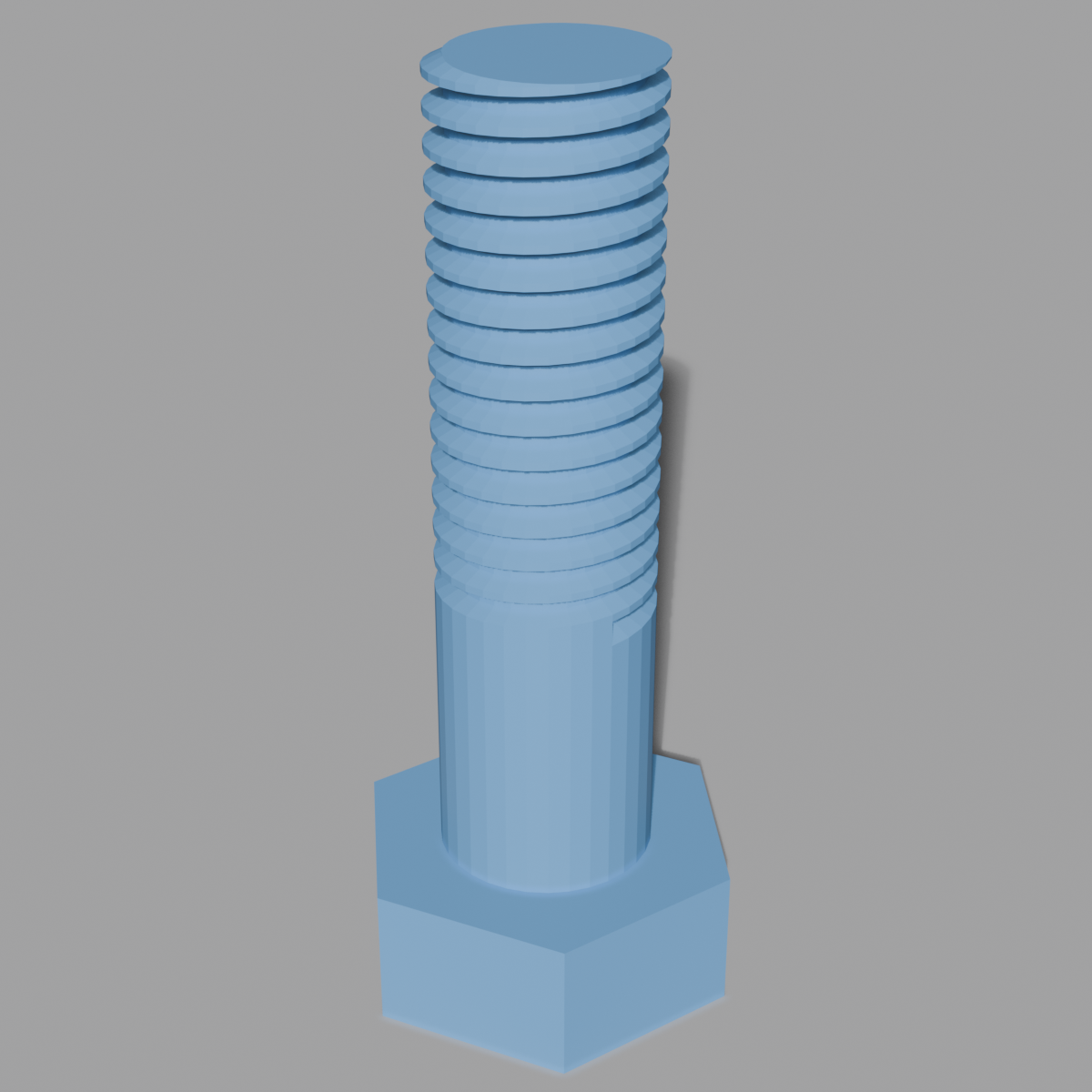
fasteners/hex_bolt.py → OBJECT_OT_hex_bolt (object.hex_bolt, "Hex Bolt")
A complete bolt — hex head, optional shank, external thread, optional tip. Built subtractively: a blank stack (shank → thread blank at the full major diameter → tip) is cut with a helical groove cutter, and the hex head is unioned on last. Reuses threaded_fastener.py's thread math (_thread_params, _build_helix, _internal_profile as the cutter) verbatim by duplication, not by import — see README.md.
Axial layout (Z, head at z=0)
hex head    [0, hex_length_mm]
shank       [hex_top, hex_top + shank_length_mm]              (if shank_enable)
thread      [shank_top, shank_top + thread_length_mm]
tip         [thread_top, thread_top + tip_length_mm]          (if tip_enable)
Properties
| Property | Type | Default | Range | Notes |
|---|---|---|---|---|
target | Object pointer | — | mesh objects with bmech_thread_diameter | Match Target; runs fastener_matching.sync_thread_dims — copies thread_diameter_mm/pitch_mm/flank_angle_deg/truncation all at once |
hex_length_mm | Float (mm) | 5.5 | 0.5–30 (soft) | Head height |
hex_across_flats_mm | Float (mm) | 13.0 | 1–100 (soft) | |
shank_enable | Bool | True | ||
shank_length_mm | Float (mm) | 10.0 | 0.1–200 (soft) | |
shank_diameter_mm | Float (mm) | 8.0 | 0.1–80 (soft) | Usually equal to thread Ø |
thread_length_mm | Float (mm) | 20.0 | 0.5–200 (soft) | |
thread_diameter_mm | Float (mm) | 8.0 | 0.5–80 (soft) | Nominal major diameter |
pitch_mm | Float (mm) | 1.25 | 0.1–10 (soft) | |
flank_angle_deg | Float (°) | 60.0 | 1–179 | 60° metric/UNC, 55° BSP, 29° ACME |
truncation | Float | 0.125 | 0.0–0.3 | |
resolution | Int | 32 | 8–128 (soft) | |
outer_compensation_mm | Float (mm) | 0.0 | 0.0–0.5 (soft) | Added to thread major radius — printed external features shrink |
fit_offset_mm | Float (mm) | 0.0 | 0.0–0.5 (soft) | Subtracted from thread diameter — a looser fit against a mating internal thread (e.g. hex_nut) whose own diameter is increased by the same offset. Never synced by Match Target |
tip_enable | Bool | True | ||
tip_length_mm | Float (mm) | 3.0 | 0.1–30 (soft) | |
tip_diameter_mm | Float (mm) | 0.0 | 0.0–80 (soft) | 0 = sharp point, >0 = flat dog-point tip. Silently clamped to just under the thread's minor Ø (see below) |
Match Target
Picking a target freezes thread_diameter_mm, pitch_mm, flank_angle_deg, and truncation together, all at once, in a driven column in draw() — unlike the gear family, there's no partial-match case here (a spur-target that only drives module/pressure-angle while leaving helix/hand editable, say): a bolt and the nut that fits it need all four thread dimensions to match exactly for the threads to physically engage, so all four freeze or unfreeze together depending on whether any valid target is set. thread_length_mm, resolution, outer_compensation_mm, and fit_offset_mm are never driven — length/resolution/compensation/fit are this part's own choices, not something the mating fastener could meaningfully specify.
Unlike the gear family, the poll here is deliberately NOT loose. A bolt (always EXTERNAL orientation) can only target INTERNAL-oriented objects — hex_nut objects, or a threaded_fastener.py raw thread currently built with thread_type='INTERNAL' — never another hex_bolt or an EXTERNAL raw thread, since there's no physical case where two external threads mate (unlike some cross-kind gear matches, which can be mechanically legitimate). See README.md for the full reasoning and the mechanism (bpy.context.active_operator lookup inside the poll) this restriction depends on — and why that mechanism can't be verified by a headless test.
Build method
- Blank stack (
_add_chained_revolve): shank → thread blank (cylinder at the fullmajor_r, not an undersized core) → tip built as one continuous solid of revolution sharing vertices at every junction, not three independently-capped primitives touching end to end. Independently-capped segments meeting at the same radius would leave duplicate coincident faces (both segments' own caps covering the identical disk) — a fragile case for theEXACTboolean solver. Chaining through shared vertices means the case can't arise.tip_diameter_mm = 0collapses the tip's final ring to a single shared pole vertex (a true point) rather than a zero-radius ring. The tip segment is a flat perpendicular step down totip_rat the thread's own end Z, then a straight non-tapered pin — not a cone. A cone would shrink the blank's diameter while the thread cutter (next step) is still cutting a constant-diameter helix through it, so the thread would run out against a shrinking target and dead-end right at the tip instead of stopping cleanly. - Thread cut: a helical groove cutter (
_internal_profile+_build_helix, withroot_flatpassed into the profile'screst_flatslot — see the module docstring) is differenced out of the thread-blank segment. The cutter's crest reach pokes slightly pastmajor_r(overlap = max(0.02, min(0.2*depth, 0.15))) so the difference has genuine volume to remove instead of a hairline touch theEXACTsolver could read as a no-op, and it runs one full pitch pastthread_length_mmso the last crest doesn't dead-end flush at the blank's flat step — see README.md.tip_diameter_mmis clamped here too: silently reduced to just under the thread's minor Ø (mutating the property itself, like gearpressure_angle_degclamping) so the tip always works as an unthreaded lead-in pin instead of building too fat to matter. - Hex head (
_add_hex_prism) built separately and unioned on last — a flush blocky join is far friendlier to theEXACTsolver than the thread cut, so the riskier step happens first and any failure surfaces before the cheap reliable one._bool_unionre-runsrecalc_face_normalsafterward, since EXACT-solver unions can come back with inconsistent winding even when topologically solid.
Panel warnings
flank_dz <= 0→ "Truncation too high — no room for flanks at this pitch" (ERROR icon).head_wall <= 0.5(wherehead_wall = across_flats/2 - thread_diameter/2) → "Head too small for thread diameter" (ERROR icon).
Unlike the raw threaded fastener, these ARE enforced — execute() re-checks flank_dz <= 0 or head_wall <= 0 and, if true, reports self.report({'ERROR'}, "Invalid geometry — check truncation and head size vs thread diameter") and returns CANCELLED. Note the execute() gate (head_wall <= 0) is looser than the draw() warning threshold (head_wall <= 0.5) — a head wall between 0 and 0.5mm shows a visible warning but still builds successfully.
Output
One object, renamed HexBolt, stamped via fastener_matching.stamp_thread: bmech_kind="hex_bolt", bmech_thread_diameter, bmech_pitch, bmech_flank_angle_deg, bmech_truncation. These properties are what a hex_nut (or a future hex_bolt targeting this one) reads back via Match Target — see the section above.