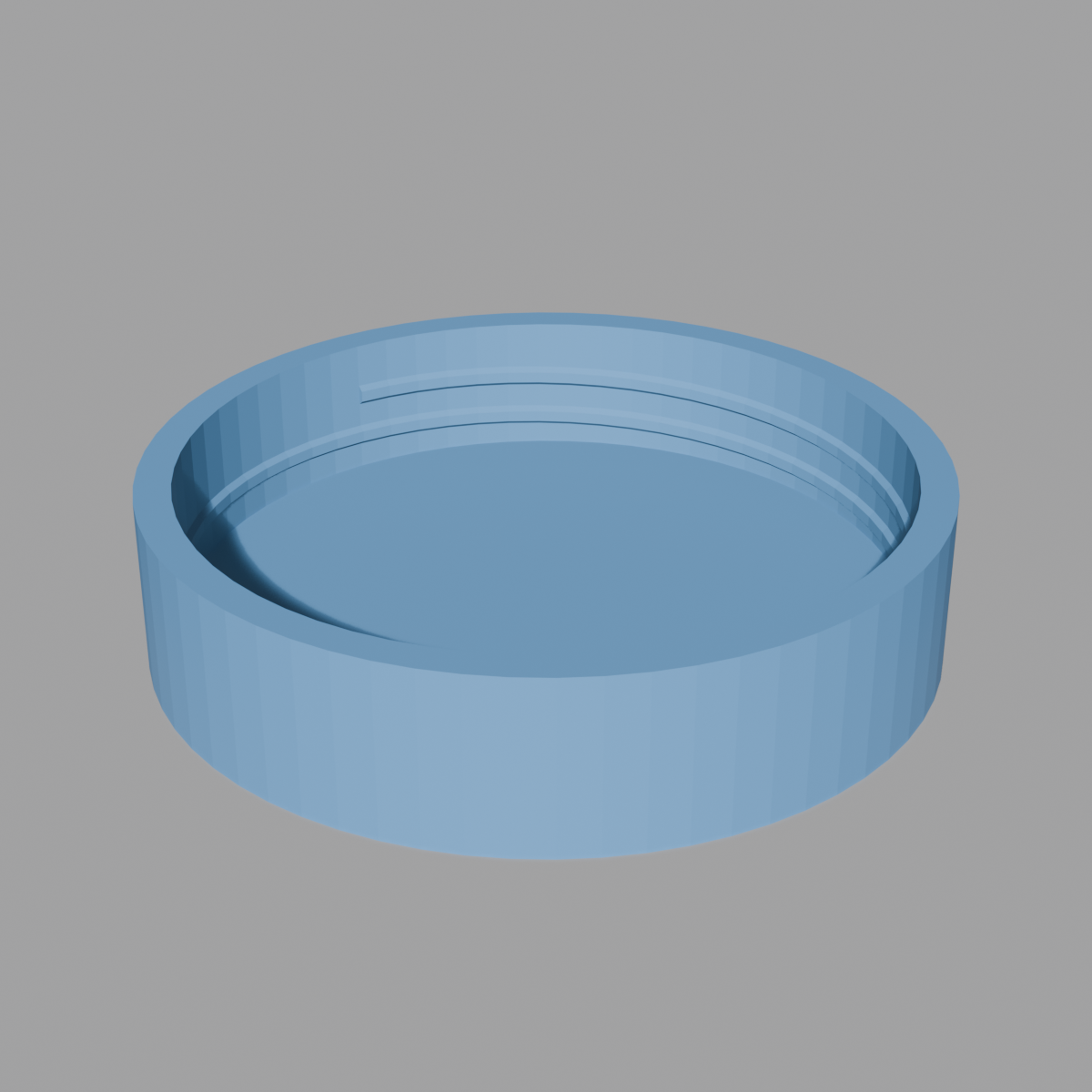
fasteners/threaded_lid.py → OBJECT_OT_threaded_lid (object.threaded_lid, "Threaded Lid")
An inverted cup that screws onto a threaded_container neck: solid cap at the top, open skirt below, with an internal thread ADDED (unioned) onto the skirt's already-hollow inner wall, anchored at the ceiling (plus a small axial gap) and extending DOWN for thread_length_mm, above an unthreaded guide zone (down to the real mouth) that lets the container's neck pass through freely before engaging the thread. thread_diameter_mm plays double duty as both "OD of the container this lid fits" and the thread's own major diameter, matching hex_bolt.py/hex_nut.py's convention so fastener_matching.sync_thread_dims works unmodified.
[REDESIGN] Every earlier version of this file cut the thread SUBTRACTIVELY out of a pre-built solid plug, mirroring hex_nut.py's recipe — which required the thread's own region of the skirt to be built solid first, a separate pilot bore, and a careful overshoot/clip dance at both ends of the cut. This version instead builds the WHOLE skirt hollow from the start and ADDS the thread as a standalone helical ridge, unioned onto the wall. See Why additive, and the tradeoff that comes with it below for why this is a deliberate choice, not an oversight.
Properties
| Property | Type | Default | Range | Notes |
|---|---|---|---|---|
target | Object pointer | — | fastener objects with the OPPOSITE (external) orientation | Match Target; runs fastener_matching.sync_thread_dims |
thread_diameter_mm | Float (mm) | 60.0 | 5–300 (soft) | OD of the container this lid fits, AND thread major diameter |
wall_thickness_mm | Float (mm) | 3.0 | 0.4–20 (soft) | Skirt wall AND cap thickness |
thread_length_mm | Float (mm) | 8.0 | 1–90 (soft), clamped up further — see Validation | How far DOWN from the ceiling the thread extends |
guide_length_mm | Float (mm) | 4.0 | 1–90 (soft) | Unthreaded lead-in below the thread, down to the real mouth — lets the container's neck self-align before engaging the thread |
pitch_mm | Float (mm) | 4.0 | 0.5–20 (soft) | Jar/bottle threads run much coarser than fastener threads |
flank_angle_deg | Float (°) | 90.0 | 1–179 | Wider than the 60° fastener convention |
truncation | Float | 0.25 | 0–0.3 | See threaded_container.md for why this is higher than the fastener default |
inner_compensation_mm | Float (mm) | 0.0 | 0–0.5 (soft) | FDM: internal features print tight — added to thread major radius |
fit_offset_mm | Float (mm) | 0.0 | 0–0.5 (soft) | FDM: added to thread diameter for a looser fit against a mating threaded_container, whose own diameter is reduced by the same offset. Never synced by Match Target |
resolution | Int | 64 | 8–256 (soft) |
height_mm is not a property — it's a pure derived sum (wall_thickness_mm + thread_length_mm + guide_length_mm), shown read-only in the panel's info box. There is no longer a fixed "total height" budget the other three have to fit inside; adding cap, thread, or guide length simply grows the part.
thread_diameter_mm/pitch_mm/flank_angle_deg/truncation freeze together in a driven column whenever a target is set, same all-four freeze behavior as hex_bolt.md. wall_thickness_mm/thread_length_mm/guide_length_mm/resolution/ inner_compensation_mm/fit_offset_mm are never driven — fit is this part's own printing-tolerance choice, not something the mating container could meaningfully specify.
fit_offset_mm folds into major_r (_derived() and _clamp() both add fit_offset_mm / 2.0 alongside inner_compensation_mm) before any of the usual truncation/thread-length clamping runs, so a large fit offset is subject to the same margin protections as a large inner_compensation_mm — it can't push minor_r to zero or below any more than compensation can.
The target picker only offers EXTERNAL-oriented objects — hex_bolt, threaded_container, or a threaded_fastener.py raw thread currently built with thread_type='EXTERNAL'. See README.md.
Why additive, and the tradeoff that comes with it
hex_bolt.py's own docstring records that this codebase tried additive (union) threading once before and abandoned it: unioning a separately-built helical ridge onto an undersized core is a numerically harder case for the EXACT boolean solver than differencing a cutter out of solid material, because a plain difference against a solid blank always has genuine material to remove, while a union of two independently-built, nearly-coincident curved surfaces can read as a hairline touch and cancel material instead of merging. See blender_extension_lessons.txt's "EXACT boolean solver" section for the general form of this lesson.
This file uses additive anyway, as a deliberate choice: the earlier subtractive design's real complexity wasn't the cut direction itself, it was the overshoot/clip dance needed because the cutter had to terminate flush with other pre-existing boundaries (the ceiling above, the clearance-zone wall below) without leaving a visible seam. An additive ridge has no such boundary to land on — it only needs to touch the surrounding wall at all, and is allowed to hard-start/hard-stop in open bore air at both ends (see the module docstring's [REDESIGN] note). The one piece of the old numerical-fragility problem that does still apply — the ridge's root radius touching the wall at exactly major_r being a hairline coincidence, not a genuine volumetric overlap — is handled the same way hex_bolt.py's old additive mode handled it: a depth-scaled radial overlap pushes the ridge's root past major_r, so the union has real volume to merge.
Swept empirically (972 configurations across thread diameter, wall thickness, thread length, guide length, pitch, flank angle, and truncation) with 0 crashes and 0 mesh defects (non-manifold edges, zero-area faces, zero volume) after the fixes below — including the crest_flat-vs-root_flat fix, which a manifold-only sweep like this one cannot catch by itself (a mesh with the crest/root duty cycle inverted is still perfectly manifold; see the profile-argument fix below, verified instead via ray-casting and real thread-to-thread engagement).
Build method
Base profile (2D, r vs z, revolved 360° around Z) — z=0 is the ceiling (top of the physical lid), z=height_mm is the real mouth (the open end the container's neck enters through), the reverse of this file's own previous z convention, adopted so height_mm falls out as a pure sum of its three parts without needing a separate "skirt depth minus cap" subtraction anywhere:
(0, 0)pole — center of the solid cap's top exterior surface- →
(outer_r, 0)— flat exterior top surface, pole to ring - →
(outer_r, height)— down the full outer wall - →
(major_r, height)— across the mouth's own annular rim (outer_rtomajor_r), the real opening the neck enters through - →
(major_r, wall_thickness_mm)— up the already-hollow, unthreaded- in-the-base-mesh bore wall from the mouth rim to the ceiling's underside - →
(0, wall_thickness_mm)pole — flat interior ceiling disc, closing the bottom of the solid cap - →
closed=Trueback to point 1: both ends are poles on the same central axis, so no face is built there at all — the cap (z=0 towall_thickness_mm, r=0 toouter_r) is one uniformly solid region.
This produces a solid cap sitting above a fully hollow skirt — there is no separate "solid plug" region and no pre-hollowed pilot bore distinction anymore, since the thread is added onto this one uniform wall rather than cut out of a thicker one. Six checkpoints total, down from eight in the previous subtractive design.
The additive thread ridge: a standalone helical solid built with _external_profile (crest pointing outward — here that's the ridge's ATTACHMENT radius, not a cutter's reach), root_flat swapped into the crest_flat slot (same convention as every other thread cutter in this family), root radius major_r + overlap, crest (tip) radius minor_r. Built directly at thread_length_mm tall with no axial overshoot — additive material terminating in open bore air needs no overshoot/clip treatment, unlike a subtractive cutter that has to avoid leaving a seam in real material. Positioned starting at wall_thickness_mm + ceiling_eps (a small pitch-scaled gap below the interior ceiling disc, avoiding an exact-coincidence hairline touch with that pre-existing face), then unioned onto the base object.
overlap = max(0.02, min(0.2 * depth, 0.15)) — the same depth-scaled radial padding hex_bolt.py's own (since-abandoned) additive mode used, so the ridge's root has genuine volumetric overlap with the wall instead of a hairline touch at exactly major_r.
[BUG, fixed] crest_flat goes in _external_profile's argument slot here — not root_flat, despite every subtractive cutter in this family passing root_flat into that exact slot. _build_helix fills its cross-section from a constant floor (here, minor_r) up to a ceiling that peaks at major_r for the argument's own plateau length. For a cutter subtracted from a solid plug, passing root_flat there makes the removed (valley) region span root_flat + 2*flank_dz — correct, since the valley should be the wide one — leaving a properly tapered tooth behind as the complement. But this file doesn't cut a complement out of solid material; it unions this exact swept shape directly as the ridge. Passing root_flat there built a solid that's fully deployed (reaching minor_r) across root_flat's own span and absent across crest_flat's span — precisely inverted from a real ridge, which must be fully deployed only across crest_flat's short span and retract flush with the wall (no protrusion at all) across root_flat's long span. Confirmed two ways: (1) ray-casting radially outward from the bore's own axis at a fixed height across 360 angles showed the root_flat version blocking 75% of the sweep (matching 2*flank_dz + root_flat) and open for only 25% (matching crest_flat) — backwards; swapping to crest_flat restored the expected 50/50 split. (2) Building a matching threaded_container and boolean-intersecting it with the lid at a fine sweep of relative axial/angular phases: the root_flat version never dropped below ~5% of its own peak interference volume at any phase (never truly "meshed"); the crest_flat version reaches exactly 0.0 interference at the correctly threaded phase and rises smoothly away from it in both directions — the signature of a real, functioning thread pair, not just a manifold mesh.
ceiling_eps = max(0.05, 0.05 * pitch_mm) — small, pitch-scaled axial gap between the ridge's own start and the interior ceiling disc.
Recalc face normals unconditionally after the union — per blender_extension_lessons.txt, EXACT-solver unions can come back with inconsistent face winding even on a genuinely manifold/solid result; _bool_op does this every time regardless of whether a defect is suspected.
[BUG, fixed] _build_helix crashes outright (not just a mesh defect) if thread_length_mm is too small relative to the thread's own profile span. _build_helix computes steps = ceil((height - profile_span) * res / pitch) + 1, where profile_span = 2*fdz + crest_flat is the axial height one full crest-to-crest repeat occupies. Once thread_length_mm <= profile_span this goes to zero or negative rings and _build_helix throws IndexError building rings[0] — confirmed empirically (e.g. thread_length_mm=4 with pitch_mm=8 crashes every time, well within both properties' own valid ranges). Fixed in _clamp() (see below) by clamping thread_length_mm up to profile_span + 0.5 * pitch_mm whenever it's smaller — a half-pitch margin comfortably guarantees several real ring steps.
Validation: clamped, not cancelled
execute() calls self._clamp() first — same clamp-over-cancel rule as threaded_container.md. Only two silent-correction steps remain (down from three in every earlier version) plus the crash-prevention floor above — since height_mm is now a pure derived sum rather than a fixed budget the other properties have to fit inside, there is no longer any "wall_thickness_mm vs. total height" conflict to reconcile at all:
truncationclamped UP (via_min_truncation_for_max_depth) whenever the resulting thread depth would pushminor_rbelow amax(1.0, major_r * 0.05)margin. Depends only onmajor_r— wall thickness plays no part, same as every earlier version.guide_length_mmclamped up tomax(1.0, 0.25 * pitch_mm)— the same margin the earlier subtractive design used for its clearance zone. The original numerical mechanism (a razor-thin exact-coincidence wall) doesn't apply the same way to an additive ridge, but the margin is kept anyway as the only guard against a guide zone too thin for the container's neck to actually self-align in.thread_length_mmclamped up to(2*fdz + crest_flat) + 0.5 * pitch_mmwhenever smaller — see the[BUG, fixed]note above; this is a crash fix, not a quality-only floor.
One case still cancels: if truncation would need to exceed 0.3 to keep minor_r positive with margin (a pitch too coarse for the thread diameter at any truncation) — no meaningful single "closest valid value" to fall back to.
draw() shows these as INFO-icon labels at the bottom of the panel (purely defensive/informational post-clamp), except the thread-length warning, which is a genuine, non-clamped, separate concern from the crash floor above:
fdz <= 0→ "Truncation too high — no room for flanks at this pitch" (can't actually occur, kept defensively).minor_r <= 0→ "Thread too deep for this diameter — minor Ø ≤ 0".thread_length_mm < 1.5 * pitch_mm(and not the above) → "Thread length < 1.5 pitches — weak engagement..." (ERRORicon, still non-blocking — confirmed in the earlier subtractive design that exactly 1.0 pitch is a mesh defect there; kept here as a weak-engagement heads-up independent of the crash-prevention clamp, which uses a different threshold based on the profile's own geometry rather than a flat pitch multiple).
Output
One object, named ThreadedLid, stamped via fastener_matching.stamp_thread: bmech_kind="threaded_lid", bmech_thread_diameter, bmech_pitch, bmech_flank_angle_deg, bmech_truncation. fastener_matching.fastener_orientation maps this kind to INTERNAL. Meshes with a threaded_container of the same four thread values.