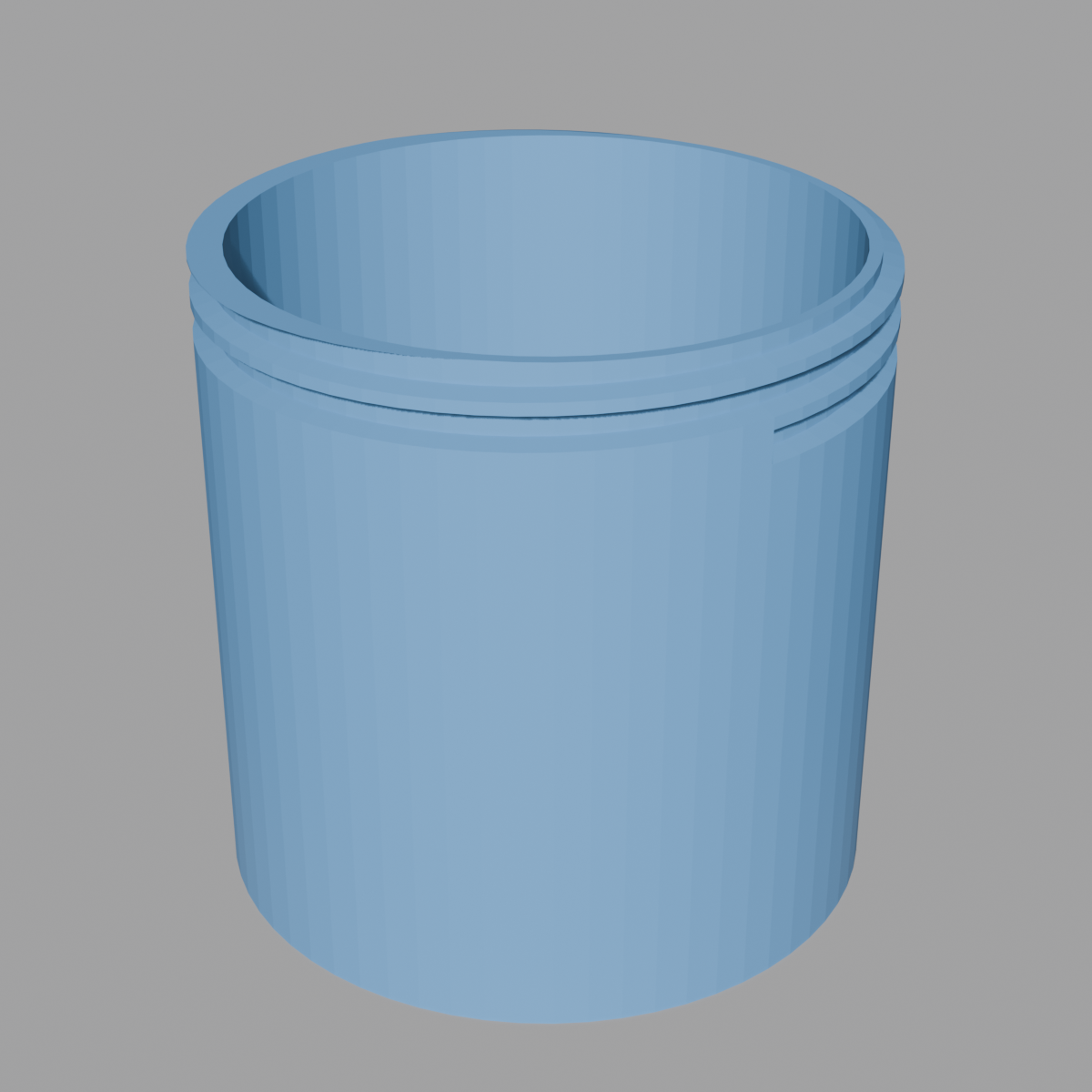
fasteners/threaded_container.py → OBJECT_OT_threaded_container (object.threaded_container, "Threaded Container")
A screw-top jar body: solid floor, straight outer wall, open mouth at the top, with an external thread cut directly into the existing outer wall near the top — no separate raised neck boss. thread_diameter_mm plays double duty as both the container's own OD and the thread's major diameter, matching hex_bolt.py/hex_nut.py's naming convention so fastener_matching.sync_thread_dims works unmodified. See README.md for the family's Match Target system this participates in.
Properties
| Property | Type | Default | Range | Notes |
|---|---|---|---|---|
target | Object pointer | — | fastener objects with the OPPOSITE (internal) orientation | Match Target; runs fastener_matching.sync_thread_dims |
thread_diameter_mm | Float (mm) | 60.0 | 5–300 (soft) | Container OD AND thread major diameter |
wall_thickness_mm | Float (mm) | 3.0 | 0.4–20 (soft) | Side wall AND floor thickness |
height_mm | Float (mm) | 60.0 | 1–500 (soft) | Total outer height, floor to rim |
thread_length_mm | Float (mm) | 10.0 | 1–100 (soft) | How far down from the rim the thread extends |
pitch_mm | Float (mm) | 4.0 | 0.5–20 (soft) | Jar/bottle threads run much coarser than fastener threads |
flank_angle_deg | Float (°) | 30.0 | 1–179 | Shallower buttress-style default than the 60° fastener convention |
truncation | Float | 0.25 | 0–0.3 | Higher default than the 0.125 fastener convention — see Build method for why |
outer_compensation_mm | Float (mm) | 0.0 | 0–0.5 (soft) | FDM: external features shrink — added to thread major radius |
fit_offset_mm | Float (mm) | 0.0 | 0–0.5 (soft) | FDM: subtracted from thread diameter for a looser fit against a mating threaded_lid, whose own diameter is increased by the same offset. Never synced by Match Target |
resolution | Int | 64 | 8–256 (soft) |
thread_diameter_mm/pitch_mm/flank_angle_deg/truncation freeze together in a driven column whenever a target is set — same all-four freeze behavior as hex_bolt.md, since a container and its mating lid need all four to match simultaneously. wall_thickness_mm/height_mm/thread_length_mm/resolution/ outer_compensation_mm/fit_offset_mm are never driven — fit, like compensation, is this part's own printing-tolerance choice, not something a mating fastener could meaningfully specify.
fit_offset_mm folds into outer_r (_derived() and _clamp() both subtract fit_offset_mm / 2.0 alongside adding outer_compensation_mm) before any of the usual wall-thickness/truncation/thread-length clamping runs, so a large fit offset is subject to the same margin protections a large negative OD change would be.
The target picker only offers INTERNAL-oriented objects — hex_nut, threaded_lid, or a threaded_fastener.py raw thread currently built with thread_type='INTERNAL'. See README.md for why this family's poll is deliberately NOT loose the way the gear family's is.
Why the default truncation is higher than the fastener convention
Jar/bottle threads use a much coarser pitch than fastener threads (4mm here vs. ~1.25mm for hex_bolt.py's default), and thread depth scales with pitch for a given flank angle and truncation (depth = flank_dz / tan(half_angle), and flank_dz scales with pitch). At the fastener family's usual truncation=0.125, a 4mm pitch at 30° flank angle produces a thread over 4.6mm deep — deeper than any reasonable container wall. truncation=0.25 cuts that to about 1.9mm, safely under the default 3mm wall. If you increase pitch_mm, raise truncation too (up to its 0.3 maximum) or increase wall_thickness_mm to keep depth < wall_thickness_mm — the panel's ERROR label ("Thread too deep for this wall — would break through to interior") fires at depth >= wall_thickness_mm, with a warning starting at 70% of that.
Build method
Base body: the same "C"-shaped chained-revolve technique threaded_lid.py uses (see that file's module docstring for the shared _add_chained_revolve helper, including its closed/cap_start/ cap_end flags) — outer-bottom pole, up the outer wall, across the open top rim, down the inner wall, inner-floor pole. Both ends are poles, so no boolean is needed for the basic hollow shape.
Thread cut: identical technique to hex_bolt.py's external thread — a helical groove cutter (_internal_profile, crest pointing inward, used subtractively), root_flat swapped into the crest_flat argument slot, a depth-scaled radial overlap so the cut has genuine volume to remove rather than a hairline touch at the wall's own true major radius, cut into the EXISTING solid wall near the top — no base-shape rework needed, unlike threaded_lid.md, because the container's outer wall is already solid at exactly the thread's major radius.
Cleanup pass required, unlike hex_bolt.py. This cut leaves a small, fixed number of zero-area sliver faces (two numerically-identical vertices within one triangle) from the EXACT solver — confirmed empirically to be independent of the cutter's axial overshoot amount (tested 0 to 2 full pitches, defect count never changed) and independent of exactly where the top boundary sits, ruling out a wind-up/coincidence theory; only mesh resolution changed the count. bmesh.ops. dissolve_degenerate (the dedicated tool for exactly this artifact class) run once after the boolean removes them completely — verified 0 zero-area, 0 non-manifold, correct positive volume afterward across a 54-combination parameter sweep.
Validation: clamped, not cancelled
execute() calls self._clamp() first, before any geometry is built — following CONVENTIONS.md's clamp-over-cancel rule, the same pattern gear_matching.clamp_pressure_angle and hex_bolt.py's own tip_diameter_mm clamp use. Rather than cancelling when a combination is invalid, three properties get silently corrected in order:
wall_thickness_mmis clamped down tomin(outer_r, height_mm) - 0.1whenever it would leave no interior cavity.truncationis clamped UP (via_min_truncation_for_max_depth, solving the closed-form relationship between thread depth andpitch_mm/flank_angle_deg/truncation) whenever the resulting thread depth would exceed 70% of the (now-valid) wall thickness. Truncation, not wall thickness or thread diameter, is what gets adjusted here — it specifically controls how much a thread's own crest/root flats blunt its depth, while the size properties are what the user actually came to set.thread_length_mmis clamped down to fit withinheight_mm - floor_z.
Only one case still cancels: if truncation would need to exceed its own max (0.3) to keep depth in check — a pitch too coarse for the wall thickness at any truncation — _clamp() returns a message, self.report({'ERROR'}, ...) fires, and execute() returns CANCELLED. This is the one combination with no meaningful single "closest valid value" to fall back to (matching bevel_gear.py's own face_width_mm >= cone_dist precedent for the same kind of genuinely irreconcilable case).
draw() still shows the same conditions as INFO-icon labels at the bottom of the panel, after the derived-values box — but they're now purely defensive/informational, since _clamp() means they should rarely or never actually fire once a build completes:
inner_r <= 0orfloor_z >= height_mm→ "Wall too thick for this OD/height — no interior cavity".fdz <= 0→ "Truncation too high — no room for flanks at this pitch" (can't actually occur —truncation's own max of 0.3 keepsfdz > 0always; kept as a defensive display, costs nothing).depth >= wall_thickness_mm * 0.7→ "Thread depth near wall thickness limit".thread_length_mm > (height_mm - floor_z)→ "Thread length near container height limit".
Output
One object, named ThreadedContainer, stamped via fastener_matching.stamp_thread: bmech_kind="threaded_container", bmech_thread_diameter, bmech_pitch, bmech_flank_angle_deg, bmech_truncation. fastener_matching.fastener_orientation maps this kind to EXTERNAL. Meshes with a threaded_lid of the same four thread values.