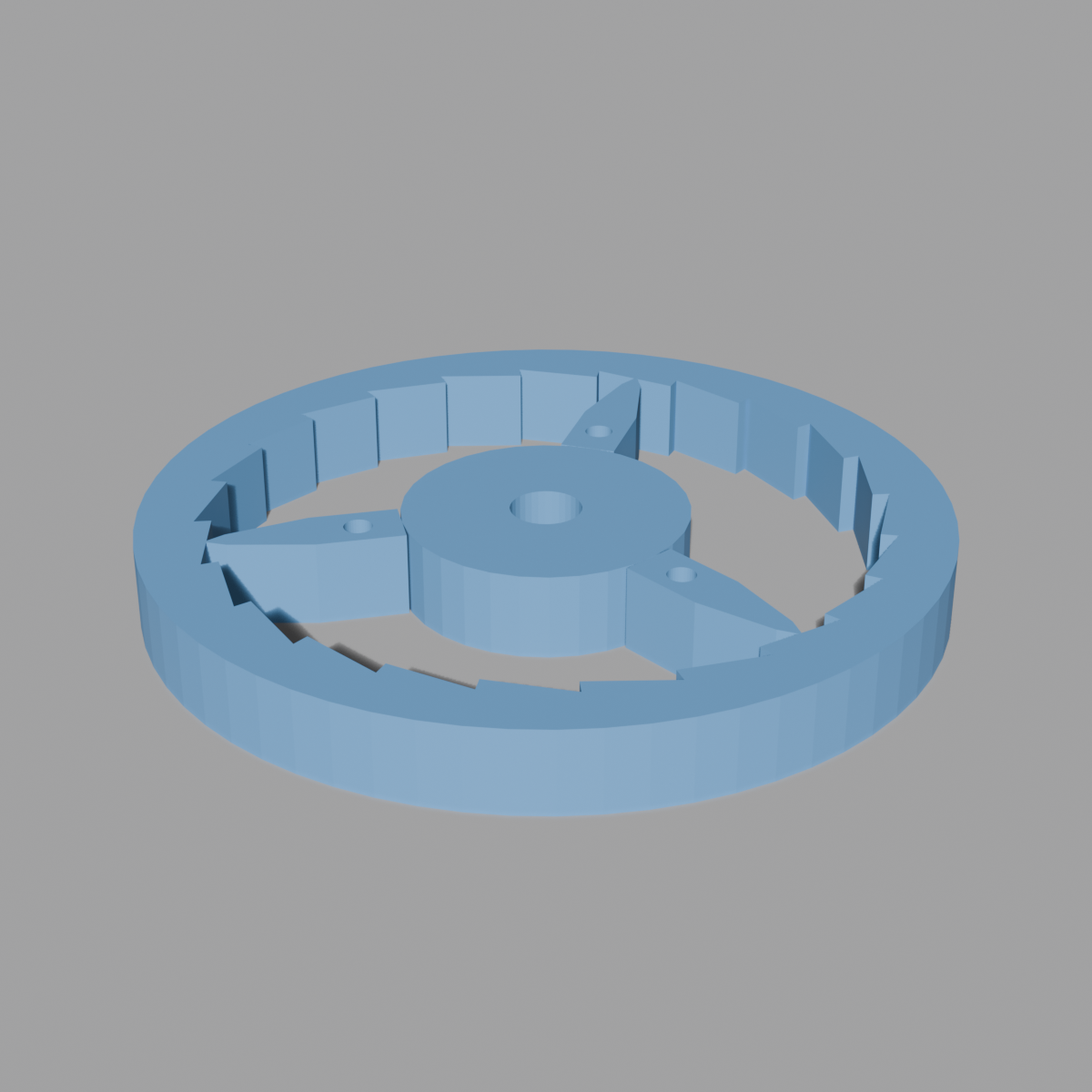
ratchets/internal_ratchet.py → OBJECT_OT_add_internal_ratchet (object.add_internal_ratchet, "Add Internal Freewheel Ratchet")
A bicycle-freewheel-style mechanism: an outer ring with inward-pointing teeth, an inner hub, and pawl_count pawls mounted on the hub pointing radially outward. CW rotation of the inner hub (viewed from +Z) = LOCK; CCW = FREE — the opposite convention from ratchet_pawl.md's external wheel, see README.md for why.
Shared constants
HOLE_SEGMENTS = 32, RING_SEGMENTS_OUT = 64 (the outer ring's own circle resolution — finer than hole segments since it's the visible outer silhouette), PIVOT_PAD_MM = 2.0.
Some geometry helpers (finalize_mesh_object, build_pawl_profile_points, a variant of create_filled_profile_with_hole) are copied from ratchet_pawl.py — see README.md.
Properties
Ring:
| Property | Type | Default | Range | Notes |
|---|---|---|---|---|
sizing_mode | Enum | MODULE | MODULE / OUTER_DIAMETER | |
tooth_count | Int | 24 | 4–200 (soft) | |
module | Float (mm) | 2.0 | 0.1–20 (soft) | |
outer_diameter_mm | Float (mm) | 50.0 | 5–500 (soft) | |
ring_wall_thickness_mm | Float (mm) | 4.0 | 0.5–50 (soft) | Radial thickness from outer surface to tooth roots |
tooth_depth_auto | Bool | True | tooth_depth_mm = 0.6 * module | |
tooth_depth_mm | Float (mm) | 1.2 | 0.1–20 (soft) | Only used when auto is off |
Hub:
| Property | Type | Default | Range | Notes |
|---|---|---|---|---|
hub_outer_diameter_mm | Float (mm) | 20.0 | 1–200 (soft) | Must be smaller than tip diameter minus clearance |
bore_diameter_mm | Float (mm) | 5.0 | 0–100 (soft) | |
bore_compensation_mm | Float (mm) | 0.0 | -2.0–2.0 (soft) | Added to bore diameter |
clearance_mm | Float (mm) | 0.3 | 0–5 (soft) | Running gap between hub surface and tooth tips — see README.md. Not a hole compensation. |
Pawls:
| Property | Type | Default | Range | Notes |
|---|---|---|---|---|
pawl_count | Int | 3 | min=1 (hard), soft_max 12 | The only property in this family (or the gear family) with a hard rather than soft minimum |
pawl_arm_length_auto | Bool | True | Computes arm length so the tip just reaches the tooth valley | |
pawl_arm_length_mm | Float (mm) | 8.0 | 1–100 (soft) | Only used when auto is off |
pawl_arm_width_mm | Float (mm) | 4.0 | 1–30 (soft) | |
pawl_tip_width_mm | Float (mm) | 1.5 | 0.1–20 (soft) | |
tip_engagement_depth_mm | Float (mm) | 0.6 | 0–10 (soft) | How far the tip projects past the tooth tips into the valley |
pivot_hole_diameter_mm | Float (mm) | 2.0 | 0–20 (soft) | |
pivot_hole_compensation_mm | Float (mm) | 0.0 | -2.0–2.0 (soft) |
Shared:
| Property | Type | Default | Range | Notes |
|---|---|---|---|---|
width_mm | Float (mm) | 6.0 | 0.5–200 (soft) | Shared by ring, hub, and all pawls |
parent_under_empty | Bool | True | Groups everything under a FreewheelRatchet empty |
Pawl positioning — radial, not tangent-biased
Unlike ratchet_pawl.py's tangent-biased heuristic solve, an internal ratchet's pawls are mounted radially outward from the hub, so the positioning math is much simpler: auto_pawl_arm_length() = max(contact_r - pivot_r, 1.0) where both the pivot and the tip contact point lie on the same radial line through the hub center. No angular bias term is needed.
Pawls are distributed at angle = i * 2*pi/pawl_count + pi/tooth_count — the +pi/tooth_count term is a half-tooth-pitch phase offset, likely so a pawl doesn't spawn straddling a tooth root/tip boundary by coincidence (not explicitly commented in the source, but the pattern is consistent across all pawl_count placements).
Ring teeth: a non-convex boundary needs a different tessellation method
build_inner_teeth_points() produces the same sawtooth pattern as the external wheel's tooth builder, with root/outer radius roles swapped so teeth point inward. But because the inner boundary is non-convex, build_ring_object() can't use bmesh.ops.triangle_fill the way every other ring-shaped generator in this library does — it uses mathutils.geometry.tessellate_polygon instead, with the outer contour wound CCW and the inner (tooth) contour wound CW as a hole. See README.md for why this matters if you're writing a new non-convex ring generator.
Drive/ramp faces per tooth (from the builder's own docstring): drive face root_i -> tip_i (radial, catches the pawl on CW hub rotation); ramp face tip_i -> root_(i+1) (angled chord, pawl slides over it on CCW/FREE rotation).
Validation
validate_freewheel() returns a list of error strings covering: non-positive ring/tip radius, tooth_depth_mm >= ring_inner_r, hub_outer_r >= tip_r - clearance_mm ("Hub outer radius must be < tip radius - clearance — reduce hub diameter or increase ring size"), bore_r >= hub_outer_r, tooth_count < 4, pawl_count < 1, pivot-hole-vs-arm-width, and pawl-arm-length-vs-pivot-hole. draw() shows every returned error at once in an "Issues:" box; execute() re-runs the same full check and cancels (CANCELLED, no self.report() message) if anything comes back non-empty — matching this family's general no-clamping discipline (see README.md).
Output
2 + pawl_count objects per call: FreewheelRing, FreewheelHub, and pawl_count pawls named FreewheelPawl.000…FreewheelPawl.%03d (zero-padded). Default pawl_count=3 gives 5 objects. If parent_under_empty, all are parented under a new FreewheelRatchet empty (PLAIN_AXES, sized to ring_outer_r * 0.3). Ring is set active. Success message: "Internal freewheel ratchet: %d teeth, %d pawls, ring Ø %.1f mm".