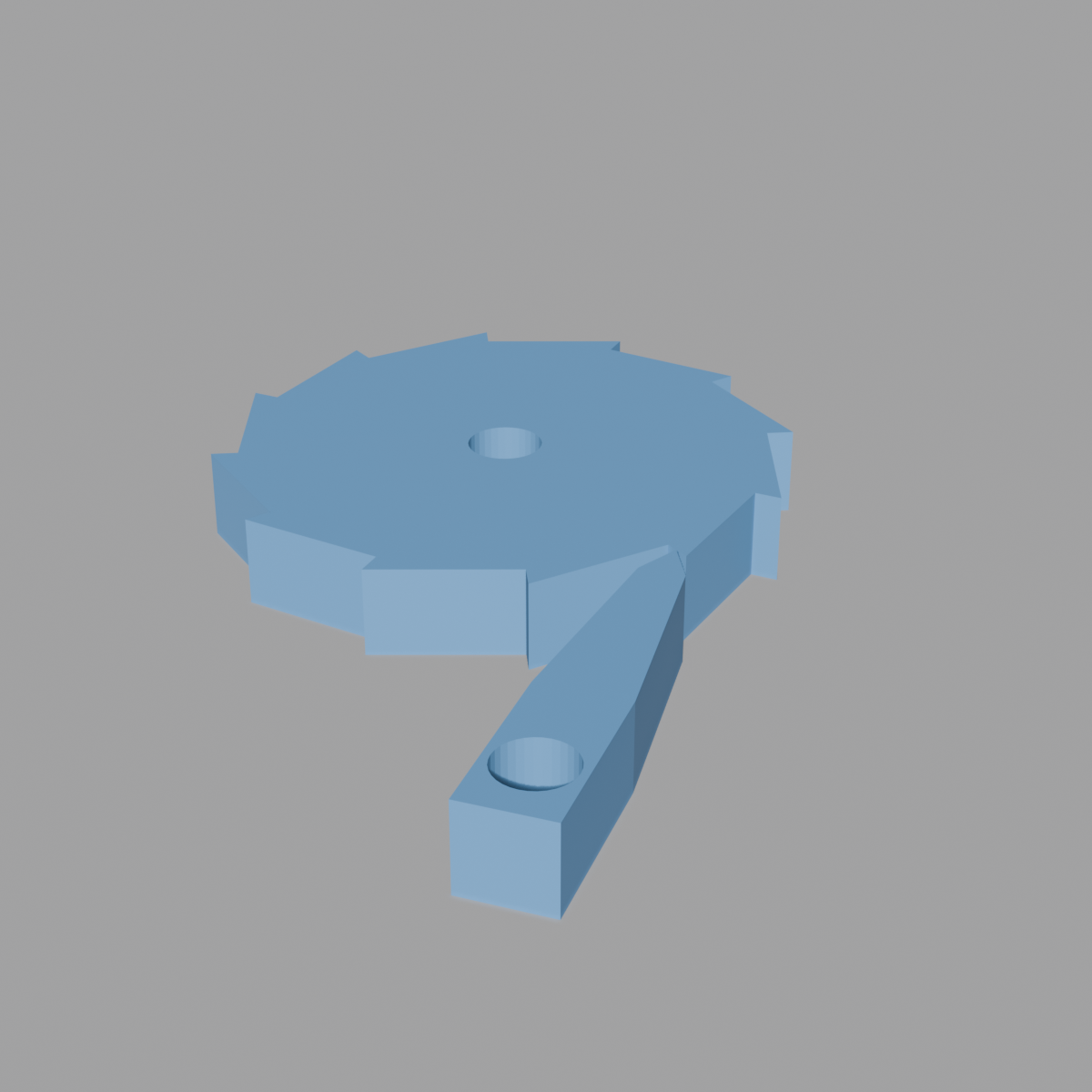
ratchets/ratchet_pawl.py — three operators sharing one set of geometry helpers: MESH_OT_add_ratchet_wheel (mesh.add_ratchet_wheel, "Add Ratchet Wheel"), MESH_OT_add_ratchet_pawl (mesh.add_ratchet_pawl, "Add Ratchet Pawl"), and OBJECT_OT_add_ratchet_mechanism (object.add_ratchet_mechanism, "Add Ratchet & Pawl") — the combined operator that builds a matched, auto-positioned pair.
Rigid, no-spring: +Z (CCW from above) wheel rotation = LOCK, -Z (CW) = FREE. See README.md for this family's shared conventions, especially the lock-direction convention (which flips for the internal ratchet) and the "no clamping, ever" validation policy.
Shared constants
HOLE_SEGMENTS = 32 (hole circle resolution), PIVOT_BIAS_ANGLE_DEG = 35.0 (tangent-vs-radial blend for the auto pivot solve, see below), PIVOT_PAD_MM = 2.0 (minimum wall thickness kept around any pivot/axle hole).
Operator 1: Add Ratchet Wheel
Properties
| Property | Type | Default | Range | Notes |
|---|---|---|---|---|
sizing_mode | Enum | MODULE | MODULE (module + tooth count, matches the gear family's convention) / OUTER_DIAMETER (outer diameter + tooth count, module back-solved) | |
tooth_count | Int | 12 | 4–200 (soft) | |
module | Float (mm) | 3.0 | 0.1–20 (soft) | |
outer_diameter_mm | Float (mm) | 40.0 | 2–500 (soft) | |
tooth_depth_auto | Bool | True | Derives tooth_depth_mm = 0.6 * module | |
tooth_depth_mm | Float (mm) | 1.8 | 0.1–50 (soft) | Only used when auto is off |
width_mm | Float (mm) | 6.0 | 0.5–200 (soft) | |
bore_enable | Bool | True | ||
axle_hole_diameter_mm | Float (mm) | 5.0 | 0.1–100 (soft) | |
axle_hole_compensation_mm | Float (mm) | 0.0 | -2.0–2.0 (soft) | Added to hole diameter |
The panel shows a read-only "Back Face Angle (derived)" label — see README.md.
Tooth profile
build_wheel_profile_points() builds a closed CCW loop with exactly 2 vertices per tooth (root, tip) — an earlier version used a two-segment back face to independently satisfy uniform spacing, a radial drive face, and a free-standing ramp angle at once; v1.1 dropped the third constraint (ramp angle became derived) and simplified to a single straight back-face segment per tooth, tip_i → root_(i+1).
Validation (raises, always cancels — see family README)
validate_wheel_params(): tooth_count >= 4; tooth_depth_mm < root_radius (else "would collapse the wheel through its own center"); axle_hole_diameter_mm < 2*root_radius (else "axle hole is bigger than the wheel"). All three are checked live in draw() (shown as an ERROR label if any fails) and re-checked in execute(), where a failure returns CANCELLED.
Output
One object, RatchetWheel. Several read-only geometry values are stashed as ID properties on the object for the combined operator (and anything else) to read back later: root_radius, outer_radius, tooth_depth_mm, sector_angle_deg, tooth_count, back_face_angle_deg.
Operator 2: Add Ratchet Pawl
Properties
| Property | Type | Default | Range | Notes |
|---|---|---|---|---|
pawl_arm_length_mm | Float (mm) | 25.0 | 2–300 (soft) | |
pawl_arm_width_mm | Float (mm) | 6.0 | 1–50 (soft) | |
pawl_tip_width_mm | Float (mm) | 3.0 | 0.1–50 (soft) | |
pivot_hole_diameter_mm | Float (mm) | 5.0 | 0–50 (soft) | |
pivot_hole_compensation_mm | Float (mm) | 0.0 | -2.0–2.0 (soft) | |
width_mm | Float (mm) | 6.0 | 0.5–200 (soft) | |
tip_engagement_depth_mm | Float (mm) | 1.0 | 0–20 (soft) | How far the tip projects into the tooth valley at full engagement. Informational only here — only the combined operator's auto-positioning solve actually consumes it. |
pivot_location | Vector (mm) | (0,0,0) | World-space pivot placement. Not part of the original spec — added so this operator is independently usable; the combined operator overrides it with its own solve. | |
pivot_rotation_deg | Float (°) | 0.0 | -360–360 (soft) |
Pawl shape
build_pawl_profile_points() builds a 7-point wedge in the pawl's local frame, pivot at the origin, arm along +X: a pivot pad (hole_radius + PIVOT_PAD_MM wide) so the pivot hole has material on all sides, a taper starting at 30% of arm length, and a wedge tip (max(tip_width_mm, 1.0) long, guarding against a degenerate zero-length wedge) ending at the true tooth-valley contact point.
Validation
Checks pawl_arm_length_mm > pivot_hole_diameter_mm + pivot_hole_compensation_mm and hole_dia < pawl_arm_width_mm, both shown in draw() and enforced in execute() (CANCELLED on failure).
One check is deliberately NOT performed here: whether pawl_tip_width_mm fits the wheel's tooth-valley width. That requires wheel geometry this standalone operator doesn't have — it's only checked inside the combined operator below.
Output
One object, Pawl. ID properties pawl_arm_length_mm, pivot_hole_diameter_mm stashed on it.
Operator 3: Add Ratchet & Pawl (combined)
Builds a matched wheel + pawl pair with the pawl's pivot auto-solved so its tip lands correctly on a real tooth drive face.
Properties
All the wheel and pawl properties above, minus width_mm (unified into a single shared field — "one field, can't diverge" per the source comment), plus:
| Property | Type | Default | Range | Notes |
|---|---|---|---|---|
center_distance_solve_mode | Enum | AUTO | AUTO (solve pivot from pawl_arm_length_mm + engagement_side) / MANUAL (use pawl_pivot_location directly) | |
pawl_pivot_location | Vector (mm) | (0,0,0) | Manual mode only | |
engagement_side | Enum | +X | +X/-X/+Y/-Y (pawl sits on that side of the wheel) / CUSTOM (uses engagement_angle_deg) | |
engagement_angle_deg | Float (°) | 0.0 | -360–360 (soft) | |
parent_under_empty | Bool | True | Groups both parts under a new RatchetMechanism empty |
Note tip_engagement_depth_mm's minimum here is 0.01, not the 0.0 used by the standalone pawl operator — the auto-solve divides by/compares against this value, so it can't be exactly zero here.
The auto-positioning solve — a heuristic, not a rigorous statics derivation
The module's own design-decision log is direct about this: it's a tangent-biased heuristic, not a moment/statics calculation. solve_pawl_pivot():
- Maps
engagement_sideto a target angle around the wheel, then snaps to the nearest actual tooth drive-face angle — "so the contact point lands exactly on a real drive face instead of in mid-air between teeth." - Computes the lock-direction tangent at that contact point (per the +Z=LOCK convention) and the outward radial direction.
- Blends them:
pivot_dir = normalize(-tangent_lock*cos(bias) + radial_dir*sin(bias))withbias = PIVOT_BIAS_ANGLE_DEG = 35°— the pivot sits mostly against the lock-direction surface velocity (so the wheel's push rotates the pawl arm further into engagement rather than out of it) plus a constant outward lean so the pivot clears the wheel body. pivot_world = contact_world + pawl_arm_length_mm * pivot_dir.
Raises ValueError (→ CANCELLED) if tip_engagement_depth_mm >= tooth_depth_mm (tip can't project deeper than the tooth itself), or if the resulting pivot still ends up inside/at the wheel's outer radius (pawl_arm_length_mm too short).
Validation — one genuine non-blocking warning in this whole file
Almost everything here follows the raise/cancel discipline described in README.md: wheel geometry checks, pawl structural checks, and the cross-part check unique to this operator — pawl_tip_width_mm >= estimate_valley_width_mm(...) ("Tip too wide for tooth valley") — all cancel on failure.
The one exception: in MANUAL pivot mode, if the manually-placed pivot ends up more than 0.5mm away from where pawl_arm_length_mm says it should be, execute() issues self.report({'WARNING'}, ...) but still builds the mechanism — "the tip won't land exactly on the drive face" is a warning you can act on or ignore, not a blocking error, since you explicitly chose manual placement.
Output
2 or 3 objects: RatchetWheel + Pawl, plus (default on) a RatchetMechanism empty parenting both. Pawl is set active. Success message reports tooth count, derived back-face angle, and which side the pawl engages on.