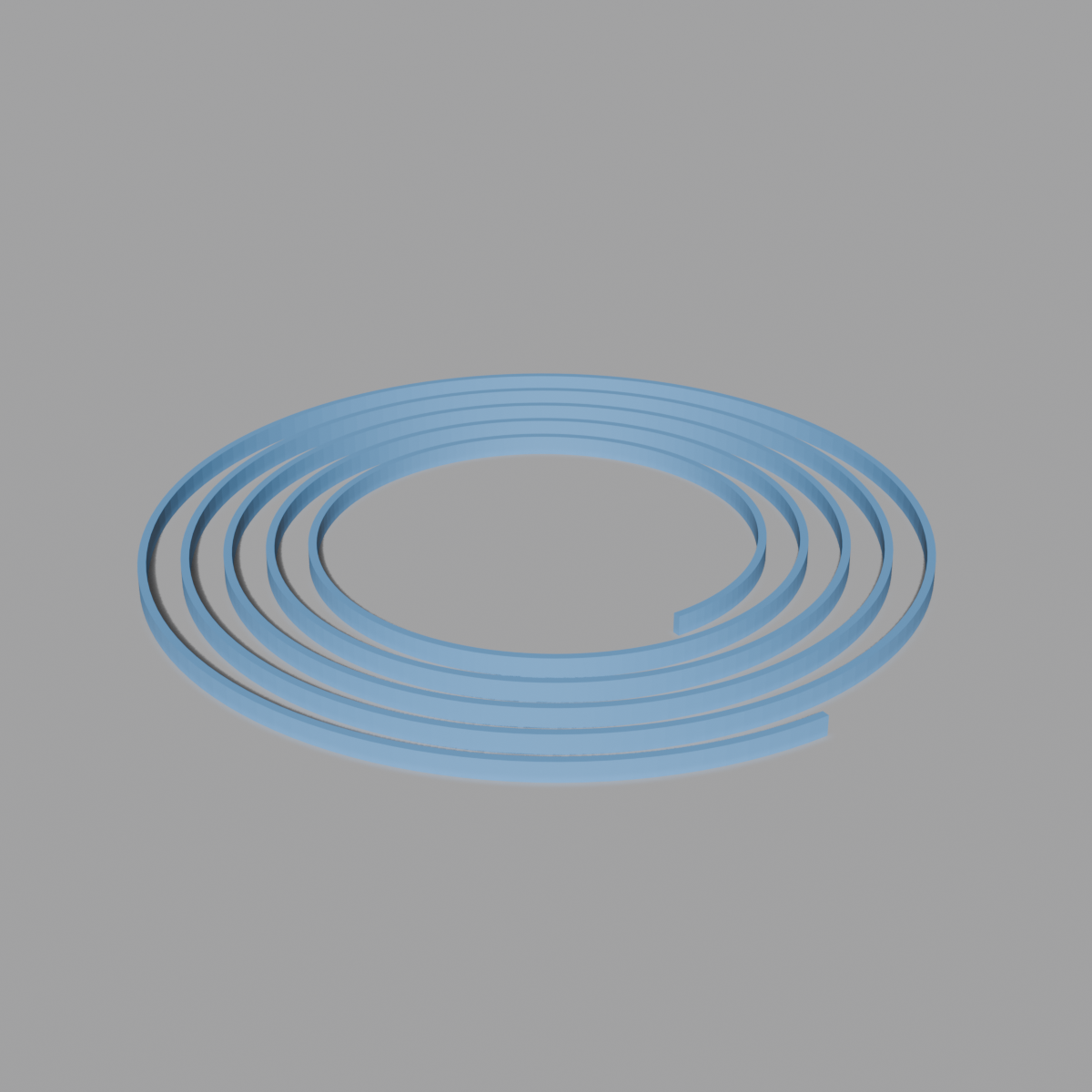
springs/hairspring.py → OBJECT_OT_add_hairspring (object.add_hairspring, "Add Hairspring")
A flat Archimedean-spiral ribbon — the kind of spring used in mechanical clock balance wheels. See README.md for family-wide notes.
The spiral formula
r(theta) = r_inner + (gap / 2*pi) * theta, theta in [0, 2*pi*turns]sampled at N = round(resolution * turns) + 1 points (minimum 2).
Properties
| Property | Type | Default | Range | Notes |
|---|---|---|---|---|
input_mode | Enum | MODE_A | MODE_A (Inner/Turns/Gap) / MODE_B (Inner/Outer/Turns) | |
r_inner | Float (mm) | 10.0 | 0.1–500 (soft) | |
turns | Float | 5.0 | 0.5–50 (soft) | |
gap | Float (mm) | 2.0 | 0.1–50 (soft) | Radial gap between adjacent coil passes. Mode A only. |
r_outer | Float (mm) | 20.0 | 0.2–500 (soft) | Radius of the outermost coil. Mode B only. |
strip_width | Float (mm) | 1.0 | 0.4–20 (soft) | Ribbon dimension in Z. FDM floor: 0.4mm. |
strip_thickness | Float (mm) | 0.4 | 0.2–10 (soft) | Ribbon dimension radially. FDM floor: 0.2mm. |
resolution | Int | 128 | 8–512 (soft) | Sample points per full turn |
Mode A vs Mode B
- MODE_A (Inner / Turns / Gap):
gap_mm = self.gapused directly; outer radius is shown as a computed read-only label. - MODE_B (Inner / Outer / Turns):
gap_mm = (r_outer - r_inner) / turnsis derived, then clamped to a 0.1mm floor. The derived gap is shown as a read-only label.
Panel warnings — only one actually blocks
- Mode B,
r_outer <= r_inner→ "Outer radius must exceed inner radius" (ERROR icon). This one does cancel —execute()returnsCANCELLEDon this exact condition in Mode B. - Mode B, derived gap
< 0.1mm→ "Derived gap below 0.1 mm — increase outer radius or reduce turns" (ERROR icon). This one does not cancel —execute()silently clampsgap_mm = max(gap_mm, 0.1)instead of stopping. The warning is real (your spiral will be denser than requested) but not blocking.
Build method
build_manual_ribbon() walks the sampled centerline points, computes a tangent at each (central difference, forward/backward at the ends), and a binormal tangent × Z as the local "width" direction — a hand-rolled sweep frame, not Blender's built-in curve-bevel machinery (hence "manual" in the function name). Each point gets 4 verts (outer/inner × top/bottom in the local frame); the ribbon is closed with start and end cap quads. strip_width becomes ribbon depth in Z; strip_thickness becomes ribbon width radially — there's no Solidify modifier involved, the thickness is built directly into the mesh.
Output
One object per call, Hairspring (mesh data HairspringMesh), placed at the 3D cursor. No success report message is printed (unlike the other two generators in this family). No bmech_* stamping.