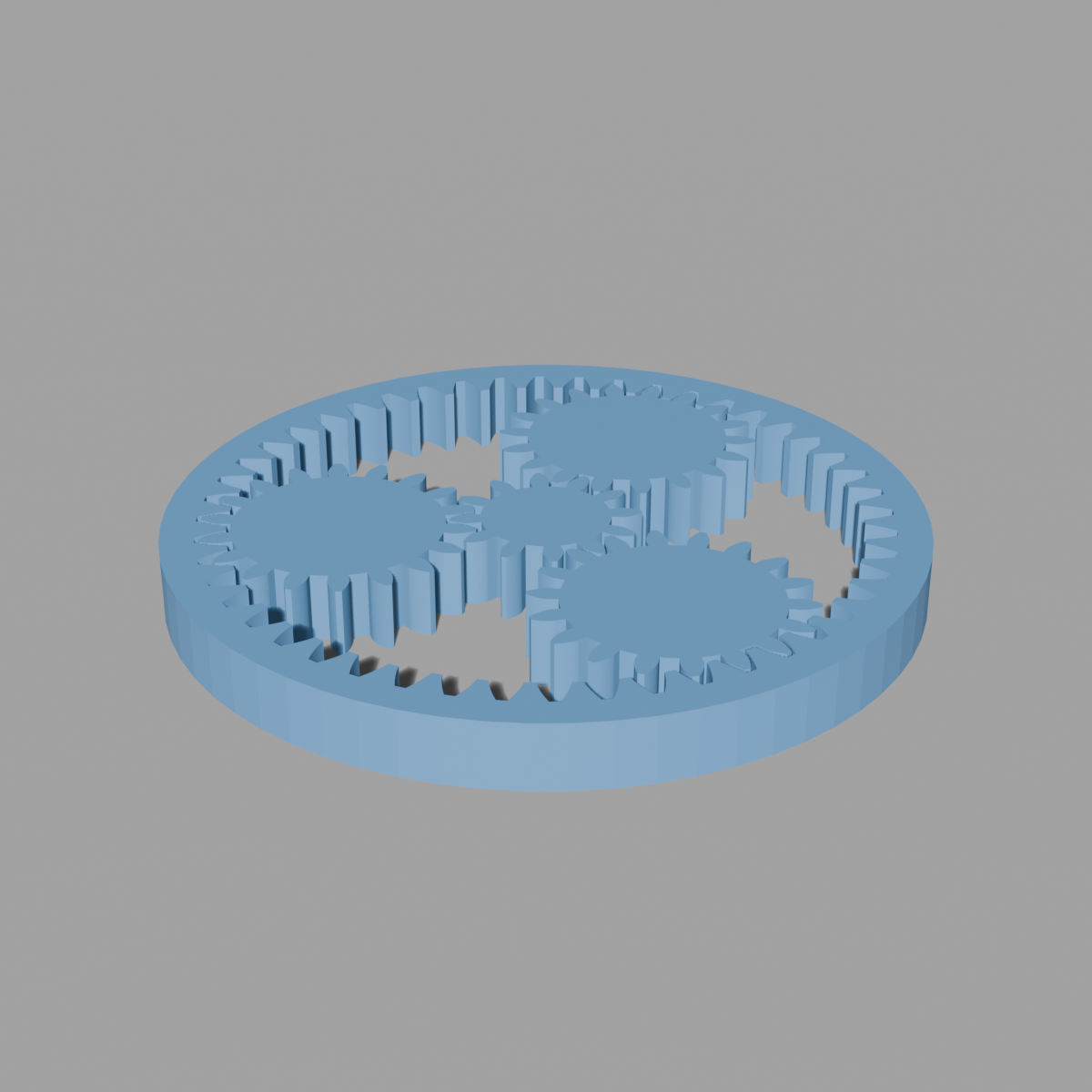
gears/planetary/planetary_gear_set.py → OBJECT_OT_planetary_gear_set (object.planetary_gear_set, "Planetary Gear Set")
Builds a complete, correctly-meshed epicyclic gear set — sun, N planets, and ring — in one operator call. Straight (spur) teeth. See README.md for family-wide conventions; this and the two other gear-set primitives are self-contained and don't use the Match Target / stamp_gear system at all (there's nothing external to mesh with — the set is already fully meshed internally).
Properties
| Property | Type | Default | Range | Notes |
|---|---|---|---|---|
sun_teeth | Int | 12 | 4–100 (soft) | |
planet_teeth | Int | 16 | 4–100 (soft) | Ring tooth count is derived: ring = sun + 2*planet |
planet_count | Int | 3 | 2–8 | (sun + ring) must be divisible by this |
module | Float (mm) | 2.0 | 0.1–20.0 (soft) | Shared by all three members |
pressure_angle_deg | Float (°) | 20.0 | 10–45 | |
width_mm | Float (mm) | 10.0 | 1–80 (soft) | Shared face width |
ring_wall_mm | Float (mm) | 5.0 | 0.5–30 (soft) | Ring gear's radial wall beyond the tooth root |
pip_gap | Float (mm) | 0.2 | 0.0–2.0 (soft) | Radial clearance at tooth tips for print-in-place |
outer_segs | Int | 64 | 16–256 (soft) | Facets on the ring's outer surface |
The two governing equations
ring_teeth = sun_teeth + 2 * planet_teeth                # exact, not optional
(sun_teeth + ring_teeth) % planet_count == 0              # even spacing
The first is geometric fact — three meshed gears on those center distances have no other valid ring size. The second is the classic planetary assembly condition: if it doesn't hold, the planets can't all be simultaneously in mesh with both sun and ring at evenly-spaced angular positions.
Violating the second condition is a warning, not a block — the panel shows an ERROR-icon label ("(%d + %d) / %d not integer — planets won't space evenly"), and execute() calls self.report({'WARNING'}, ...), but still builds the geometry. Take the warning seriously; the set will look assembled but the planets will not actually be correctly phased.
Planet placement
angle_step = 2*pi / planet_count
theta_i    = i * angle_step                                    # i = 0..planet_count-1
position   = center_dist * (cos(theta_i), sin(theta_i))        # center_dist = r_sun + r_planet
rotation_i = -theta_i * (sun_teeth/planet_teeth) + pi/planet_teeth
The rotation term is what keeps every planet correctly meshed with the sun regardless of where around the circle it sits — each planet's own spin is tied to its orbital angle by the sun/planet tooth ratio.
The ring is then given a fixed phase correction, rotation_euler.z = -pi / ring_teeth, independent of planet count: the boolean cutter used to carve the ring's teeth has slot centers at k * 2*pi/ring_teeth, putting ring teeth at (2k+1) * pi/ring_teeth; -pi/ring_teeth is exactly the offset needed to land a ring tooth at each planet's mesh valley.
pip_gap — not the same thing as bore compensation
pip_gap adds radial clearance at tooth flanks so a planetary set printed fully pre-assembled (print-in-place) doesn't fuse its own meshing teeth together. It's implemented as two different geometric effects depending on which side it's applied to: it thins an external gear's tooth (sun, planet), and widens the annulus cutter's slot (ring) — same parameter, opposite direction, because both need to open up the same physical gap. This is unrelated to bore_compensation on other primitives, which deals with hole tolerance, not tooth backlash.
Note this generator does not nest sun/planet/ring into a single print-in-place assembly the way pip_gap's name might suggest for other mechanisms in this library (see the ratchet/hinge generators for that pattern) — sun, planets, and ring are always separate objects; pip_gap only controls backlash between them if you do print them pre-assembled.
Build method
Sun and planets are built directly via bmesh extrusion (flat profile, straight extrude — no boolean, no twist). The ring is a solid cylinder (outer_r = r_ring + 1.25*module + ring_wall_mm) with an annulus cutter boolean-subtracted (EXACT solver), same pattern as annulus_gear.md. All planet_count planets are linked copies of a single shared mesh datablock — editing one planet's mesh in Edit Mode will edit all of them.
Output
2 + planet_count objects per call (5 by default): PlanetaryRing, PlanetarySun, and PlanetaryPlanet.001…PlanetaryPlanet.00N. The ring is the active object after creation. Success message: "Planetary: %d/%d/%d teeth (sun/planet/ring), module %.1f, %d planets".
No hand, no helix — spur teeth only. For twisted-tooth versions, see helical_planetary_gear_set.md and herringbone_planetary_gear_set.md, which share every formula in this document except the mesh builders themselves.