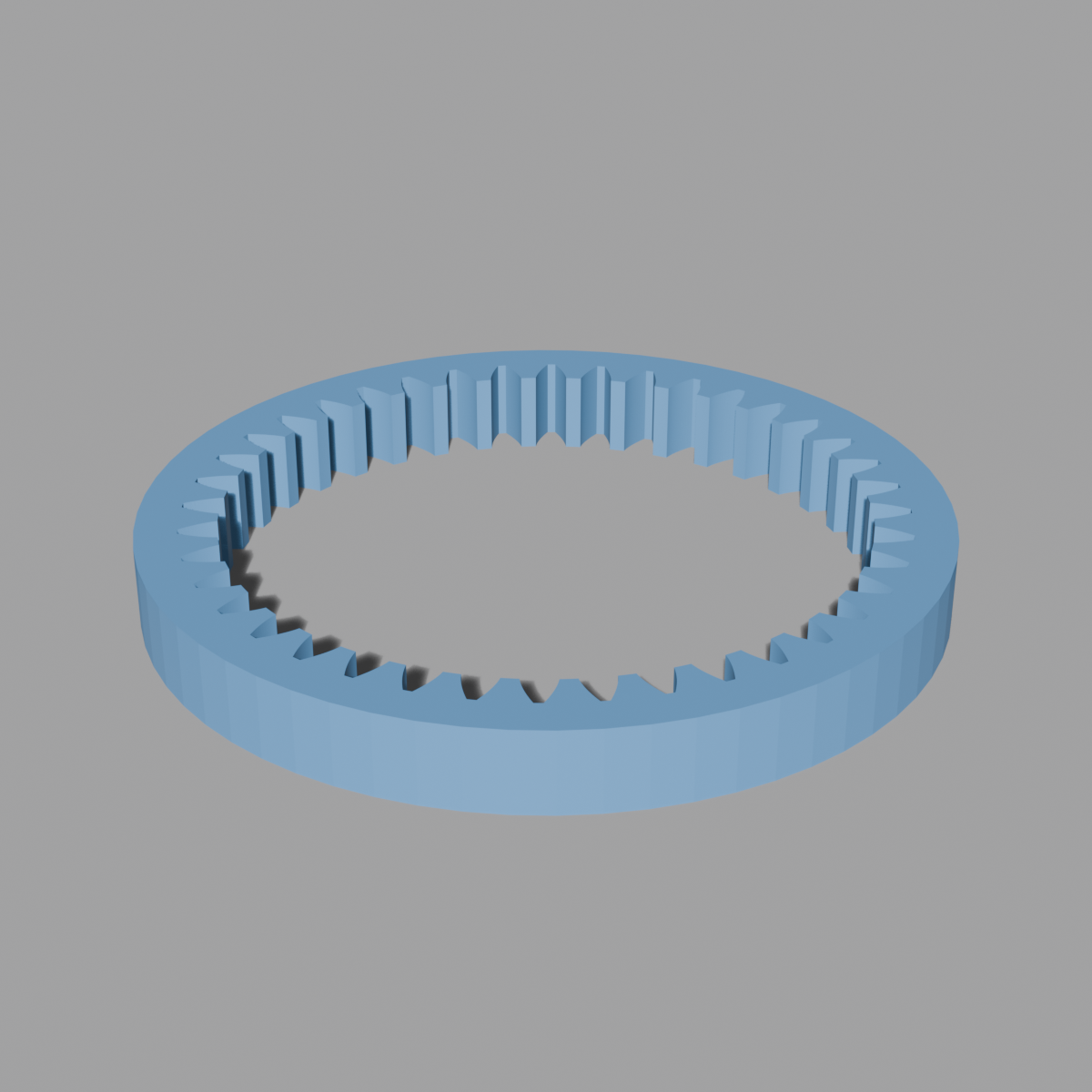
gears/ring/annulus_gear.py → OBJECT_OT_annulus_gear (object.annulus_gear, "Annulus Gear")
Straight-tooth internal gear — involute teeth cut into the bore of a solid ring, meshing with a spur pinion running inside it. See README.md for family-wide conventions.
Properties
| Property | Type | Default | Range | Notes |
|---|---|---|---|---|
target | Object pointer | — | gears with bmech_module | Match Target; runs sync_module_pa — copies module/PA only (no hand/helix on a straight gear) |
tooth_count | Int | 40 | 8–200 (soft) | Must exceed the mating pinion's tooth count |
module | Float (mm) | 2.0 | 0.1–20.0 (soft) | Transverse module — must match the mating pinion |
pressure_angle_deg | Float (°) | 20.0 | 10–45 | |
width_mm | Float (mm) | 10.0 | 1–80 (soft) | |
ring_wall_mm | Float (mm) | 5.0 | 0.5–30 (soft) | Radial wall thickness beyond the tooth root |
outer_segs | Int | 64 | 16–256 (soft) | Facets on the outer cylindrical surface |
Meshing rule
Same module and pressure angle as the pinion, and avoid tooth_count(annulus) - tooth_count(pinion) < 12 — too few teeth of difference risks interference between the ring's addendum and the pinion's addendum with standard tooth proportions.
Addendum/dedendum roles are swapped
An internal gear's teeth point inward, so the usual addendum/dedendum roles invert relative to an external gear:
pitch_r      = module * tooth_count / 2
tip_r        = pitch_r - module            # ADDENDUM_COEFF role, now shrinks the radius
root_r_inner = pitch_r + 1.25*module       # DEDENDUM_COEFF role, now grows the radius
outer_r      = root_r_inner + ring_wall_mm
The cutter that carves these teeth is built by the exact same profile code as an external gear's tooth (_build_annulus_cutter_profile), just with ADDENDUM_COEFF and DEDENDUM_COEFF swapped in role — ded_r becomes what reaches inward to the bore (tip), and add_r becomes what stays out near the ring body (root).
Build method
No boolean, no Solidify modifier — the ring is built directly with bmesh. This used to be a solid outer cylinder minus a boolean-DIFFERENCE tooth cutter (EXACT solver); that was ~80-180x slower in testing (295ms-5.8s for tooth counts 8-100, scaling badly with tooth count) and was the most sluggish generator in the whole gear family. The direct construction produces the identical shape in 3.7-35ms.
_build_annulus_solid builds four pieces directly:
- The inner (toothed) wall: consecutive points of the tooth profile connected vertically between the two Z layers — same idea as an external gear's own tooth-wall construction.
- The outer (cylindrical) wall: a separate, independently-spaced circle (
outer_segspoints) connected the same way. This is deliberately not built with one point per tooth-profile point at a matching angle — a matched 1:1 correspondence looks like it would let the two loops bridge directly into a clean cap, but doesn't work: the tooth profile inserts a dedendum-circle point at the same angle as its neighbor whereverbase_r > ded_r(a genuine straight undercut-flank segment, not a mistake), and bridging to a same-angle outer point puts three points on the same ray through the origin — an unavoidably zero-area triangle regardless of how the resulting quad gets split. Confirmed by testing: a matched-angle outer ring reintroduces non-manifold edges and zero-area faces at low tooth counts (8/15/20) that treating the outer ring as fully independent does not. - The two end caps, each built with
bmesh.ops.triangle_fillfed the boundary edges of both loops together in one call.triangle_filltreats the inner loop as a hole in the outer loop's polygon and triangulates the actual annular region directly, with no trouble from the profile's collinear-point segment, since it isn't assuming any point correspondence between the loops at all — see README.md for the fuller history (a fan-from-a-center- vertex approach was tried and produced degenerate zero-area cap faces; a naive index-matched bridge was tried next and produced the same degenerate faces for a different reason;triangle_fillfed both loops together is what actually works).
Pressure angle clamp has extra margin, specifically for this generator
_derived() clamps pressure_angle_deg to gear_matching.max_pressure_angle_deg(...) - PA_TRIANGLE_FILL_MARGIN_DEG (0.2°), not the theoretical self-intersection limit itself the way other gear generators do via gear_matching.clamp_pressure_angle. Right at that limit the tooth tip's flank points become near-coincident — the old boolean-based EXACT solver tolerated a profile sitting exactly there, but bmesh.ops.triangle_fill's constrained triangulation does not, and produced real non-manifold edges (292-844 of them, in testing) without this margin. 0.2° reliably clears it for tooth counts up to ~100 — the range that covers virtually every practical FDM design.
Known limitation, not fixed: at very high tooth counts (100+, already far beyond typical printable annulus gear sizes) combined with a pressure angle that gets clamped, an occasional tiny residual (2-6 non-manifold edges, out of tens of thousands) can still appear. It does not correlate cleanly with pressure-angle margin, outer_segs, or their ratio in testing — it behaves like floating-point noise in triangle_fill's own triangulation at extreme profile complexity, not a parameter with an obvious closed-form fix. Swept 8-100 teeth × the full pressure-angle range: 166/168 combinations (98.8%) built completely clean; the 2 failures were both tooth_count=100 with a requested pressure angle (40-45°) far above what actually gets used after clamping (~31°) — i.e., only reachable by deliberately asking for an unrealistic value at an already-extreme tooth count.
No hand or helix concept anywhere in this generator — it's a pure straight-tooth internal gear.
Panel warnings
Only one check across all three annulus generators (straight, helical, herringbone): tip_r <= 0 → "Module too large — tip radius ≤ 0" (ERROR, blocks). There is no rim-thickness or undercut-specific warning for annulus gears, unlike the external-gear family — if you set ring_wall_mm too thin, nothing in the panel will flag it.
Output
One object, stamped:
gear_matching.stamp_gear(body, "annulus", module, pressure_angle_deg,
                          tooth_count=tooth_count)
Meshes with a spur pinion of the same module and pressure angle.