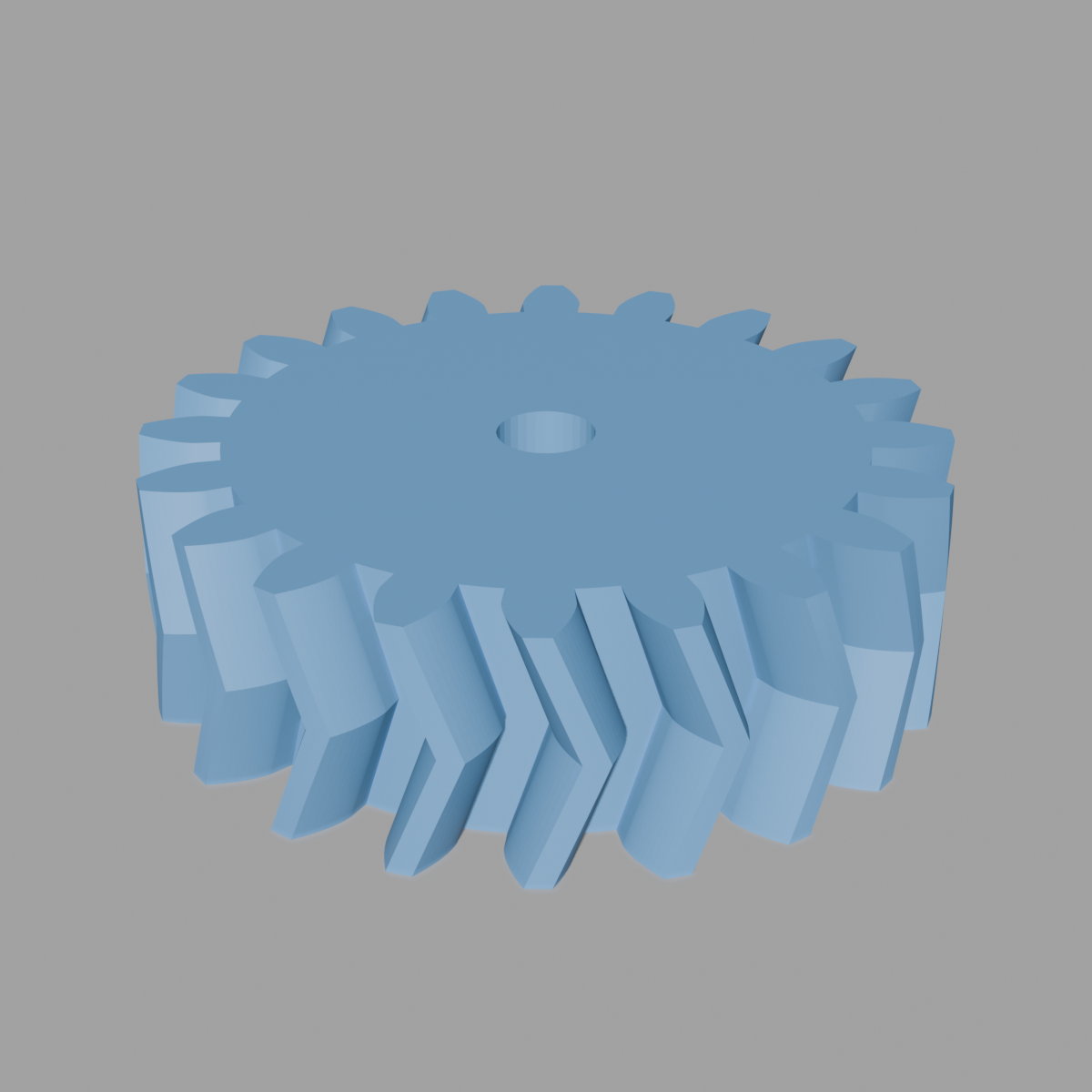
gears/external/herringbone_gear.py → OBJECT_OT_herringbone_gear (object.herringbone_gear, "Herringbone Gear")
External involute gear with V-shaped (double-helical) teeth — two mirrored helical halves meeting at mid-width, canceling axial thrust so no thrust bearing is needed on the shaft. See README.md for family-wide conventions and the hand-convention rules.
Properties
| Property | Type | Default | Range | Notes |
|---|---|---|---|---|
target | Object pointer | — | gears with bmech_module | Match Target; runs sync_helical_opposite — copies module/PA/helix angle, inverts hand |
tooth_count | Int | 20 | 5–200 (soft) | |
module | Float (mm) | 2.0 | 0.1–20.0 (soft) | Transverse module |
pressure_angle_deg | Float (°) | 20.0 | 10–45 | |
helix_angle_deg | Float (°) | 20.0 | 1–45 | Half-angle of the V; 15–30° typical for FDM |
hand | Enum | RIGHT | RIGHT / LEFT | RIGHT = bottom half twists CW from below |
width_mm | Float (mm) | 14.0 | 2–80 (soft) | Full face width — each half is width_mm/2 |
bore_enable | Bool | True | ||
bore_diameter | Float (mm) | 5.0 | 0.1–50 (soft) | |
bore_compensation | Float (mm) | 0.2 | 0.0–1.0 (soft) | Added to bore radius |
n_slices | Int | 12 | 2–48 (soft) | Per half. Total slices built = 2*n_slices - 1 |
Hand doesn't cancel thrust — it still has to match
A herringbone gear has zero net axial thrust regardless of which hand you pick — that's the whole point of the V shape. But hand still determines which way the V opens, and mating herringbone gears still need opposite hands (same external-external rule as helical gears) for the two V's to nest correctly. Don't assume hand is irrelevant here just because thrust isn't at stake.
Build method
Same slice-and-twist approach as the helical gear, done twice and mirrored:
bottom half, z: 0 → width/2       twist rises 0 → peak
top half,    z: width/2 → width   twist falls peak → 0
peak_twist = (width/2) * tan(helix_angle) / pitch_radius
The top-half loop starts at slice index 1, not 0, because slice 0 of the top half is the same vertex ring as the last slice of the bottom half (the shared peak at mid-height) — skipping it avoids a duplicate ring. Total slice count is therefore 2*n_slices - 1, shown as a read-only info line.
End caps here use center-fan triangulation (an added center vertex per face, fanned to the rim), unlike the helical gear's flat n-gon caps — a structural difference worth knowing if you're editing the generator code, though it makes no visible difference to the output.
Bore cutting is identical to the helical gear's approach.
Panel warnings
Same two checks as helical gear: dedendum_radius <= 0 (ERROR, blocks) and bore_r >= dedendum_radius (ERROR). The info box additionally shows Half width, Peak twist, and Total slices.
Unlike helical gear, this operator does call self.report({'INFO'}, "Herringbone: %d teeth, %.1f° helix, %.1f mm wide") on success.
Output
One object, stamped:
gear_matching.stamp_gear(obj, "herringbone", module, pressure_angle_deg,
                          tooth_count=tooth_count,
                          helix_angle_deg=helix_angle_deg, hand=hand)
Meshes with: another herringbone gear (opposite hand), or a herringbone annulus gear (same hand — see herringbone_annulus_gear.md).