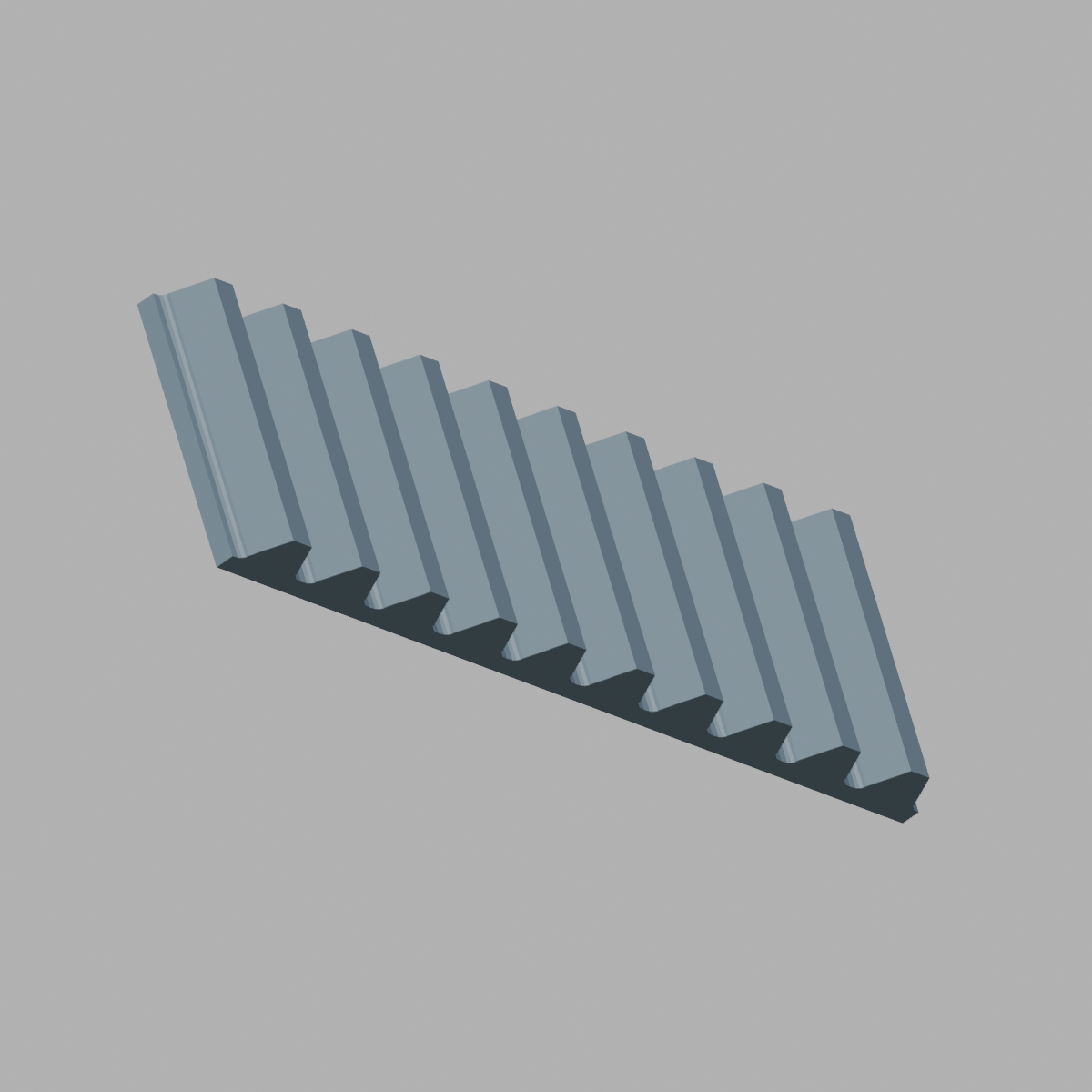
gears/rack/helical_rack.py → OBJECT_OT_helical_rack (object.helical_rack, "Helical Rack")
A straight rack whose teeth are sheared along X as a linear function of Z — the gear-of-infinite-radius limit of helical_gear.md's twist. Meshes with a helical pinion of the same module, pressure angle, and helix angle, and the same hand — not the opposite hand the external-external gear-gear rule would suggest. See README.md for why a rack is the exception: it contacts its pinion at a different relative angular position (directly below, θ=-90°) than two side-by-side external gears do (θ=180° apart), and that's what flips the sign.
Properties
| Property | Type | Default | Range | Notes |
|---|---|---|---|---|
target | Object pointer | — | gears with bmech_module | Match Target; runs sync_helical_same, and if the target has bmech_tooth_count, also updates tooth_count_rack |
module | Float (mm) | 1.0 | 0.1–50.0 | Must match the mating pinion's module |
pressure_angle_deg | Float (°) | 20.0 | 10–45 | |
helix_angle_deg | Float (°) | 20.0 | 1–45 | Tooth shear angle; 15–30° typical for FDM |
hand | Enum | RIGHT | RIGHT / LEFT | Teeth shear toward +X as Z increases when RIGHT |
length_mode | Enum | TOOTH_COUNT | TOOTH_COUNT / MATCH_GEAR | Same semantics as straight_rack.md |
tooth_count_rack | Int | 10 | 2–1000 | Used directly in TOOTH_COUNT mode; fallback in MATCH_GEAR mode if no target is set |
width_mm | Float (mm) | 10.0 | 1–100 (soft) | Full extent along the shear (Z) axis |
No bore properties, no n_slices — see Build method below for why.
Hand and Match Target freezing
Same freeze pattern as helical_gear.md: module/ pressure_angle_deg freeze whenever any target is set; helix_angle_deg freezes only when the target itself stamps bmech_helix_angle_deg (a spur-gear target never drives it, matching sync_helical_same's own guard); hand freezes with helix_angle_deg except when gear_matching.hand_target_ambiguous(False, target) is true — i.e. when this rack (plain-helical style) is matched against a herringbone target, since a plain helical rack only meshes one half of a herringbone pinion's V, and which hand is correct depends on which half. See README.md for the full rationale — this rack follows exactly the same logic helical_gear.py uses for gear-gear pairs.
Build method
*No n_slices property, unlike every helical/herringbone gear. A helical gear twists by rotating each Z-slice's profile by an angle that grows nonlinearly relative to straight-line interpolation between slices, so more slices measurably improve the approximation to the true curved helical surface. A helical rack instead shears* the profile — x' = x + hand_sign * z * tan(helix_angle), a transform that is linear in z. A straight 3D edge between the bottom-layer vertex (x, y, 0) and the top-layer vertex (x + shear(width), y, width) passes exactly through (x + shear(z), y, z) for every z in between (parametrize t = z/width: both the edge and shear(z) scale identically with t). This is an exact affine identity, not an approximation, so exactly two Z-layers — bottom and top — reproduce the sheared surface with no faceting error at any resolution. Adding an n_slices property here would misleadingly suggest a smoothness/accuracy tradeoff that doesn't exist for this shape.
shear(z) = z * tan(helix_angle) — note there's no division by pitch radius, unlike the gear's twist_angle(z) = z * tan(helix_angle) / pitch_radius. The rack is the pitch-radius-→-∞ limit of the gear case: the arc-length displacement of any profile point (radius * twist_angle(z)) converges to the radius-independent constant z * tan(helix_angle) as radius grows without bound, since displacement at any fixed radius on the pitch circle is what a rack tooth's true straight-line motion represents.
Otherwise reuses straight_rack.py's tooth-profile math verbatim (build_rack_tooth_profile/build_rack_profile, duplicated here per this family's per-file mesh-helper convention — see README.md), tiled across X, then two straight-side-quad layers connect the sheared bottom and top n-gon faces.
Swept tooth counts 2–50 × pressure angles 14.5–30° × helix angles 5–44° × both hands: 0 non-manifold edges, 0 zero-area faces (checked on the evaluated mesh — see straight_rack.md for why the raw pre-modifier/pre-eval mesh isn't the right thing to check; this generator has no modifiers at all, everything is baked bmesh geometry, but the same "evaluate before trusting" habit caught this reliably).
Hand fix — why this needed correcting after initial release
The first version of this file reused sync_helical_opposite (the external-external gear-gear rule) on the assumption that a rack, having external tooth geometry, follows the same hand rule as two side-by-side external gears. It doesn't. The two cases contact at different relative angular positions on the pinion — two side-by-side gears contact at a θ=180°-apart pair of points (each gear's contact point faces the other), while a rack sitting directly below its pinion contacts at the pinion's own θ=-90° point (a 90°, not 180°, offset from a θ=0° reference). That difference changes the sign of the tooth-flank-slope relationship the hand rule depends on.
This was caught by direct empirical testing, not just re-deriving the angle math: building a 30°-helix pinion together with a rack of the same module/PA/helix at each hand value and computing the actual mesh intersection volume (bmesh.ops.boolean INTERSECT, EXACT solver) gave 0 mm³ for same-hand and ~376 mm³ of gross tooth interpenetration for opposite-hand. Independently, extracting real mesh vertices from the gear confirmed its tooth flank at the rack-facing contact point shifts by measured dx/dz ≈ +tan(helix_angle) for hand='RIGHT' — exactly matching this file's own shear(z) formula with no sign flip needed there. The fix was entirely in bmech_sync_target (swap sync_helical_opposite for sync_helical_same) and the hand-property/docs wording — the shear math itself was already correct.
Phase alignment
Beyond the Y-drop-by-pitch-radius and X-centering every rack does when a target is set (see straight_rack.md), a rack also applies gear_matching.rack_phase_align_x(target, tooth_count_rack) — an extra X shift so the rack spawns with a gear tooth centered in a rack gap (and vice versa) rather than an arbitrary phase.
This is cosmetic, not a correctness fix. Standard (zero-profile-shift) involute teeth are in conjugate contact at every point along the path of contact — every rotational phase of a correctly-dimensioned pair is interference-free. Without this shift, whether the rack spawns looking "nicely meshed" (tooth-into-gap) or "tooth stabbing into tooth" (not actually wrong, just a confusing snapshot to hand a user) is arbitrary, driven by whichever tooth-count/tooth-count-parity combination the user happened to pick.
Why tooth_count_rack's parity has to be part of the calculation, not just the target's tooth count — a mistake made and caught in this file's own first draft: the existing X-centering formula (half_rack_length - tooth_pitch/2) already puts either a rack tooth-center or a rack gap-center at the target's local x=0, depending on whether tooth_count_rack is odd or even (a rack tooth sits there for odd counts, a gap for even). A first version of rack_phase_align_x computed a shift purely from the gear's own tooth phase, blind to that parity. Hand-checking a concrete case caught it: a module=2, 40-tooth gear's own tooth phase happens to sit exactly at the meshing point (θ=-90° is an exact multiple of that gear's tooth-pitch angle) — but for a 10-tooth rack (even), the pre-existing centering formula independently puts a rack gap at that same point already, meaning the two effects already canceled into perfect gap-alignment with zero shift needed. The naive gear-only formula didn't know that, and would have added a half-tooth-pitch shift that moved this already-correct pairing into tooth-on-tooth instead — while doing nothing wrong for an 11-tooth (odd) rack against the same gear, where the parity-blind and parity-aware formulas happen to agree. Verified after the fix across gear tooth counts {17, 20, 39, 40, 41} × rack tooth counts {5, 10, 11, 20, 21} (a mix of odd/ even/coprime-with-40 combinations chosen to stress exactly this parity interaction): all 25 combinations land with a rack tooth center exactly tooth_pitch/2 away from the nearest gear tooth center — true gap alignment, not tooth-on-tooth, at every single tooth count parity tested. Confirmed unchanged for the helical and herringbone variants too (checked at their own θ=0 reference slice, since the same-hand fix keeps the shear in sync with the gear's twist across the full width once aligned at one slice).
Output
One object, name HelicalRack (or HelicalRack.001, etc.), stamped:
gear_matching.stamp_gear(obj, "helical_rack", module, pressure_angle_deg,
                          helix_angle_deg=helix_angle_deg, hand=hand)
Meshes with a helical pinion (helical_gear.md) of the same module, pressure angle, and helix angle, and the same hand.