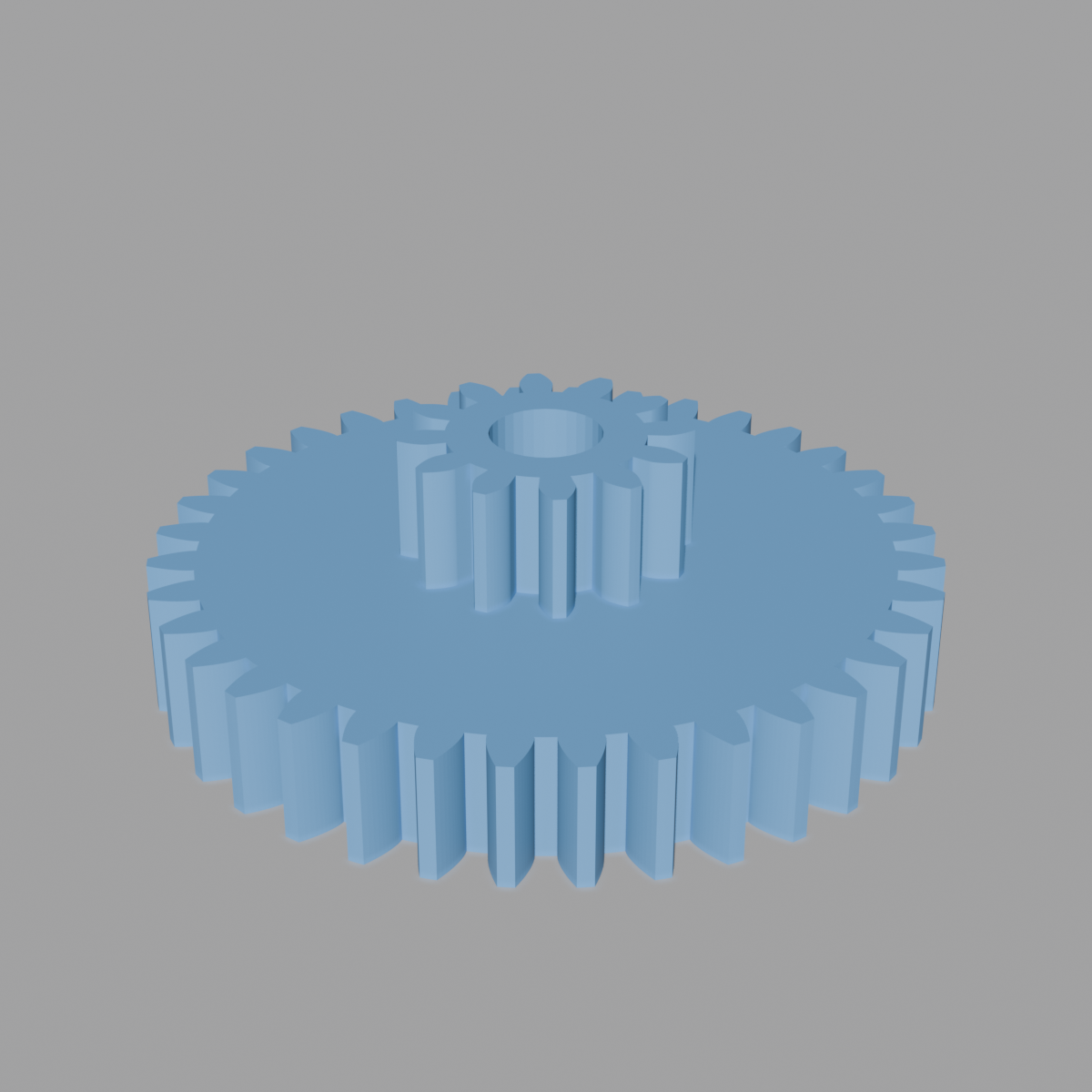
gears/external/cluster_gear.py → OBJECT_OT_add_cluster_gear (object.add_cluster_gear, "Add Cluster Gear")
Two involute spur gears of different sizes, stacked on one shared axle and printed as a single monolithic piece (smaller gear on top of the larger one). Common in gear trains where two shafts need to be replaced by one compound shaft. Self-contained like the planetary sets — no stamp_gear, no Match Target. See README.md for family-wide conventions.
Properties
| Property | Type | Default | Range | Notes |
|---|---|---|---|---|
bottom_teeth | Int | 36 | 4–200 (soft) | Gear at the base |
top_teeth | Int | 12 | 4–200 (soft) | Gear on top |
module | Float (mm) | 1.0 | 0.1–50.0 | Shared by both gears |
pressure_angle_deg | Float (°) | 20.0 | 10–45 | |
width_bottom | Float (mm) | 6.0 | 0.5–50 (soft) | |
width_top | Float (mm) | 6.0 | 0.5–50 (soft) | |
bore_enable | Bool | True | ||
axle_hole_mm (labeled "Bore Ø") | Float (mm) | 5.0 | 0.1–50 (soft) | |
axle_compensation_mm | Float (mm) | 0.2 | 0.0–1.0 (soft) | Added to hole radius |
The geometric constraint that makes this work
The two gears are fused at their junction plane (Z = width_bottom) by bridging the bottom gear's top edge loop to the top gear's bottom edge loop with a single triangulated "shoulder" face. This only produces valid geometry if the top gear's outer diameter is smaller than the bottom gear's dedendum diameter — i.e. the top gear must sit entirely within the bottom gear's top face at that junction, not overhang it. The panel doesn't check this directly; if you set top_teeth/module large enough to violate it, expect a broken or self-intersecting shoulder face rather than an error message.
The one constraint the panel does check is the axle bore against both gears' dedendum radii: if bore_r >= min(dedendum radii of top and bottom gears), the panel shows an ERROR-icon label, "Axle hole too large — max Ø %.2f mm for smallest gear". This is a warning-style label — it doesn't block execute().
Build method
Reuses spur_gear.build_gear_profile() for both gear profiles (unlike the planetary-set files, which keep their own duplicate copies of the profile builder). The whole part — bottom gear, shoulder, top gear — is assembled as one continuous bmesh solid, not two separate objects boolean-unioned; no coincident/duplicate faces at the junction. If a bore is enabled, it's cut afterward as a single boolean-DIFFERENCE cylinder through the entire height (EXACT solver, ±BOOL_EPSILON extension — same pattern as the rest of the family).
Output
One object per call, ClusterGear / ClusterGearMesh. Success message: "Cluster gear: %d / %d teeth, %.2f mm tall". Straight teeth only — no hand, no helix.