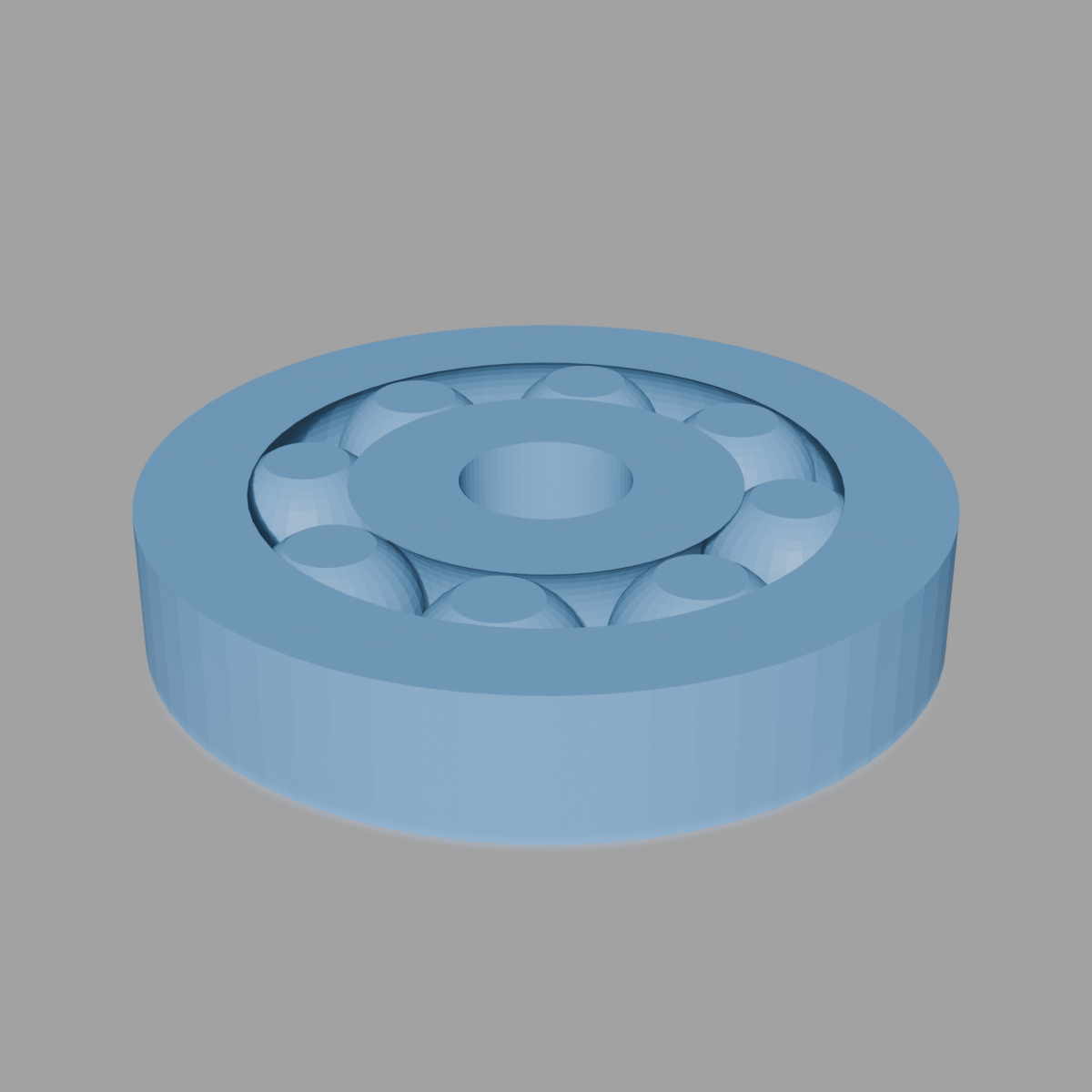
bearings/ball_bearing.py → OBJECT_OT_add_ball_bearing (object.add_ball_bearing, "Add Ball Bearing")
Generates an inner race, an outer race, and ball_count truncated-sphere balls — a complete, FDM-assemblable ball bearing. See README.md for family-wide notes.
Pitch diameter is derived from ball packing, not typed in
ball_center_r = (2*ball_radius_mm + gap_mm) / (2*sin(pi / ball_count))You specify bore ID and outer OD directly; everything else (pitch circle, groove radius, wall thicknesses) is derived from those two plus the ball geometry.
Properties
| Property | Type | Default | Range | Notes |
|---|---|---|---|---|
bore_diameter_mm | Float (mm) | 6.0 | 0.1–500 (soft) | Inner race ID (axle bore) |
outer_diameter_mm | Float (mm) | 28.0 | 0.2–600 (soft) | Outer race OD |
ball_sizing_mode | Enum | RADIUS | RADIUS (ball radius is the input, height shown read-only) / HEIGHT (truncated height is the input, radius shown read-only) | |
ball_radius_mm | Float (mm) | 3.0 | 0.5–50 (soft) | |
ball_height_mm | Float (mm) | 5.196 | 0.1–100 (soft) | Flat-to-flat height of the truncated ball |
overhang_angle_deg | Float (°) | 30.0 | 1–89 | Maximum printable overhang from horizontal — ball caps are cut at this latitude so no supports are needed |
ball_count | Int | 8 | min 3, soft 6–40 | More balls = larger derived pitch circle |
gap_mm | Float (mm) | 0.5 | 0.05–5 (soft) | Clearance between adjacent ball surfaces |
clearance_mm | Float (mm) | 0.2 | 0.0–2 (soft) | Groove radius = ball_r + clearance/2. Increase if the bearing binds after printing. |
parent_under_empty | Bool | True |
Truncated balls — why, and how they're sized
Balls aren't full spheres — both poles are cut flat at overhang_angle_deg from horizontal, specifically so the top/bottom caps sit flush with the race faces and print without support material. The ball zone itself is open at top and bottom (not enclosed by the races) so balls can physically be dropped in during FDM assembly.
z_cut  = ball_radius_mm * cos(overhang_rad)     # truncation half-height
r_flat = ball_radius_mm * sin(overhang_rad)     # radius of the flat cap
ball_sizing_mode just picks which of ball_radius_mm / ball_height_mm is the driving input — in HEIGHT mode, ball_radius_mm = ball_height_mm / (2 * cos(overhang_rad)) is solved backward from the requested flat-to-flat height.
Auto-corrected wall thickness
Unlike most validation in this library, _compute() doesn't just flag a too-thin wall — it silently widens the geometry to fix it: if the inner or outer wall would fall under MIN_WALL_MM = 0.8mm, the bore is shrunk or the outer diameter is expanded (whichever is needed) until both walls clear that floor, before any geometry is built. The panel shows this happening via an INFO-icon note ("Bore reduced to %.2f mm to maintain %.1f mm inner wall" / "OD expanded to %.2f mm to maintain %.1f mm outer wall") — if your bearing's bore or OD comes out different from what you typed, this is why; check the panel note rather than assuming the input was ignored.
The panel's wall-thickness rows use a checkmark/error icon per wall (>= MIN_WALL_MM = checkmark, else error), but because of the auto-correction above, the error state is effectively unreachable through normal use — it would only show if some other code path bypassed _compute()'s correction.
There's also a separate validate_bearing() function defined in the module (raw error-string checks: ball radius ≤ 0, degenerate truncation, non-positive gap/bore, OD ≤ bore, wall-too-thin) that is never called by either draw() or execute() — it's dead code, superseded by the auto-scaling approach. Don't rely on it running; it doesn't.
Build method
Both races are 2D (r, z) profiles (bore/OD wall, then a semicircular groove arc spanning ±alpha_cut around the ball contact latitude) revolved 360° into a bmesh (RACE_SEGMENTS = 64 segments). Each ball is a UV-sphere-style mesh (BALL_LAT = 16 rings × BALL_LON = 32 segments) with both poles collapsed to a single flat-cap vertex ring at ±z_cut instead of a true pole point — that's the "truncated sphere."
Balls are placed evenly around the derived pitch circle: (ball_center_r*cos(angle), ball_center_r*sin(angle)) for angle = 2*pi*i/ball_count.
The only real cancellation path is a caught ValueError/RuntimeError around the three build calls — silent, no self.report() message.
Output
2 + ball_count objects per call: BearingInnerRace, BearingOuterRace, and BearingBall.000…BearingBall.%03d (zero-padded, sharing no mesh data — each ball is its own independent mesh, unlike the gear family's linked-copy planets). If parent_under_empty, all are parented under a new BallBearing empty (PLAIN_AXES, sized to outer_r * 0.3). Inner race is set active. Success message: "Ball bearing: bore Ø%.2f mm, OD Ø%.2f mm, %d balls, width %.2f mm".
No bmech_* stamping — this generator has no Match Target system.